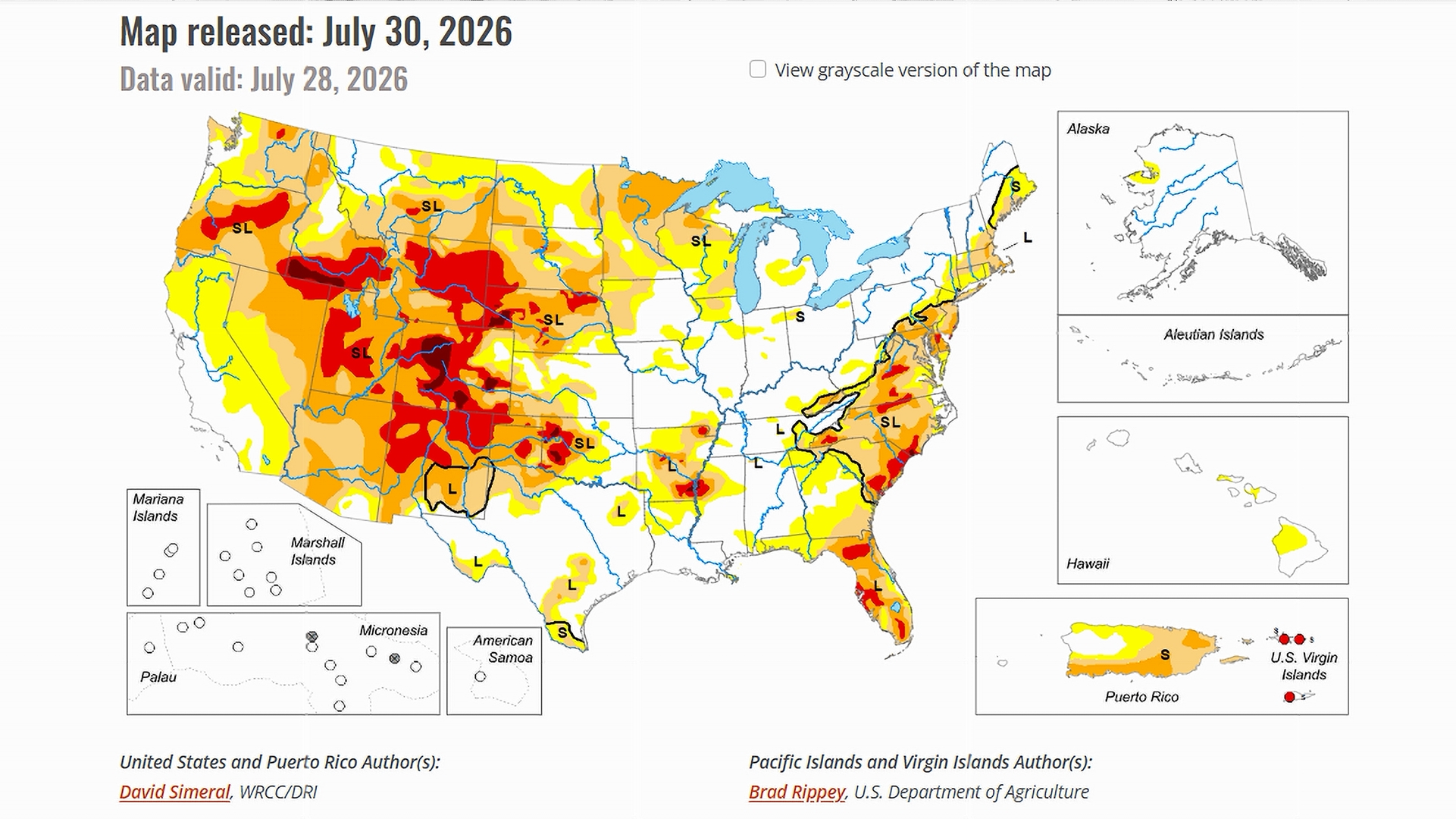
- Summer monsoon storms brought above-normal rain to much of Arizona and eased drought across parts of the Southwest.
- Lake Powell and Lake Mead each fell to their lowest late-July levels in 30 years.
- Colorado grew hotter and drier, with drought spreading across the state’s eastern and higher-elevation areas.
Saturday, August 1 2026 — The latest U.S. Drought Monitor , released earlier this week on July 30, 2026, showed a nation divided between wet and dry weather. Across much of the Western United States and the Plains, temperatures climbed well above normal. That heat pulled moisture out of the soil and plants at a fast pace. Conditions worsened quickly in the Upper Midwest, the Northern Plains, Colorado, and the Texas Panhandle.
The story was different in the eastern part of the country. Heavy rain across the Mid-Atlantic, the Southeast, and the South brought broad relief. In North Carolina, rainfall for the week ranged from 3 to more than 8 inches, which improved conditions statewide. In the Upper Midwest, though, drought expanded, and readings pointed to severe and extreme flash drought in Minnesota and Wisconsin.
Out West, the Four Corners states kept getting helpful monsoon rain, with some spots collecting 2 to 4 inches. That sets the stage for a mixed picture across the seven Colorado River Basin states of Arizona, California, Colorado, Nevada, New Mexico, Utah, and Wyoming.
Monsoon Rains Bring Relief to the Southwest.
The summer monsoon has done real work in the Southwest. Since June 15, an active monsoon pattern has delivered above-normal rain, and Arizona has led the way. Rainfall in parts of southeastern, central, and northern Arizona has run from 150 percent to 250 percent of normal.
Over the past 30 days, Arizona and western New Mexico both saw above-normal precipitation. That rain lifted streamflow and soil moisture and helped vegetation recover. The improvements showed up on the map in Arizona, northwestern New Mexico, southeastern Utah, and northeastern Nevada. In the Great Basin, recent monsoon rain gave minor relief to eastern Nevada.
The National Weather Service office in Tucson reported above-normal monsoon rainfall this season at a long list of Arizona communities, including Nogales, Sierra Vista, Wilcox, Ajo, Globe, Apache Junction, Flagstaff, Kingman, Page, Prescott, Show Low, and Winslow.
Colorado and the High Country Dry Out.
Not every basin state got good news. In Colorado, drought expanded and grew more intense. The report tied that to unusually warm temperatures, falling soil moisture, and high evaporative demand, which is the amount of water the air pulls from the ground and plants. Conditions also worsened in eastern New Mexico and southeastern California.
Heat played a large role. Over the past 30 days, several basin cities ranked among their warmest on record. Montrose and Dinosaur, Colorado, each posted their warmest such stretch on record. Grand Junction, Trinidad, and Denver came in second warmest. Rock Springs and Casper, Wyoming, ranked third warmest, and Salt Lake City, Utah, ranked fifth warmest.
Powell and Mead Sink to 30-Year Lows.
The basin’s two largest reservoirs remain the clearest sign of long-term strain. According to the U.S. Bureau of Reclamation, readings from late last week showed Lake Powell at 23 percent full. That figure sat at 33 percent of average for the date, the lowest on record for the date in the past 30 years.
Lake Mead was not far behind at 27 percent full, or 45 percent of average for the date, which was also the lowest on record for the date in the past 30 years. The full Colorado River system stood at 33 percent of capacity, down from 39 percent at the same point last year.
California’s Reservoirs Stay Full.
California offered a bright spot. The state’s reservoirs stayed at or above their historical averages for the date. Lake Shasta and Lake Oroville, the two largest, dipped slightly over the past week but held strong. Shasta measured 99 percent of average, and Oroville measured 108 percent of average.
Arizona’s Salt and Verde Systems.
Closer to the desert cities, the Salt River Project reported its Salt River reservoir system at 48 percent full and its Verde River system at 59 percent full. The combined system stood at 50 percent full, down from 59 percent full a year ago.
The Week Ahead.
Forecasters expect the split pattern to continue. The five-day outlook calls for isolated monsoon rain in the Four Corners states, with totals of 1 to 2 inches, while most of the Intermountain West, the Great Basin, and the West Coast stay dry.
Looking a bit further out, the six to ten day temperature outlook for August 3 through 7 favors above-normal warmth across most of the country. The highest odds center on California, the Great Basin, the Desert Southwest, and the central and southern Rockies. The matching precipitation outlook favors above-normal rain in parts of the Southwest, while below-normal rain is favored across the northern Rockies, the northern Great Basin, and the western Plains.