
- California opened applications for $46 million in new grants on June 11, 2026, to fight pollution in the Tijuana River and New River.
- San Diego County launched an economic impact study last week to measure what the decades-long sewage crisis has truly cost the region.
- Tijuana’s City Hall approved a formal proposal last week calling on Mexico’s federal water agency to clean out the river channel.
- A company with ties to a Trump donor received a $2.5 million no-bid federal contract to test an experimental water treatment on the Tijuana River.
- Advocates credit a 2025 endangered rivers report with helping push the United States and Mexico toward a landmark pollution agreement.
Thursday, June 25, 2026 — The Tijuana River has been making news on both sides of the border. In the span of just two weeks, California announced tens of millions of dollars in new grants, San Diego researchers asked the public for help measuring the economic damage, Tijuana’s city government pushed its own federal authorities to act, and a little-known Ohio company found itself at the center of controversy for its unusual approach to cleaning one of America’s most polluted rivers.
Here is what is happening, and why it matters.
A River That Belongs to Two Nations but Troubles One Community.
The Tijuana River starts in Mexico and flows north into the United States, emptying near the Pacific Ocean at the southern edge of San Diego County. Along the way, it picks up raw sewage, industrial waste, plastic bags, tires, mattresses, and other debris from Tijuana’s overburdened drainage systems. When those pollutants cross the border, they foul beaches, sicken residents, and choke fragile coastal wetlands.
The New River faces a similar problem. It flows northward across the border through the Imperial Valley city of Calexico and eventually reaches the Salton Sea, some 60 miles inland. Like the Tijuana River, it carries raw sewage, industrial runoff, and solid waste from Mexico into U.S. territory.
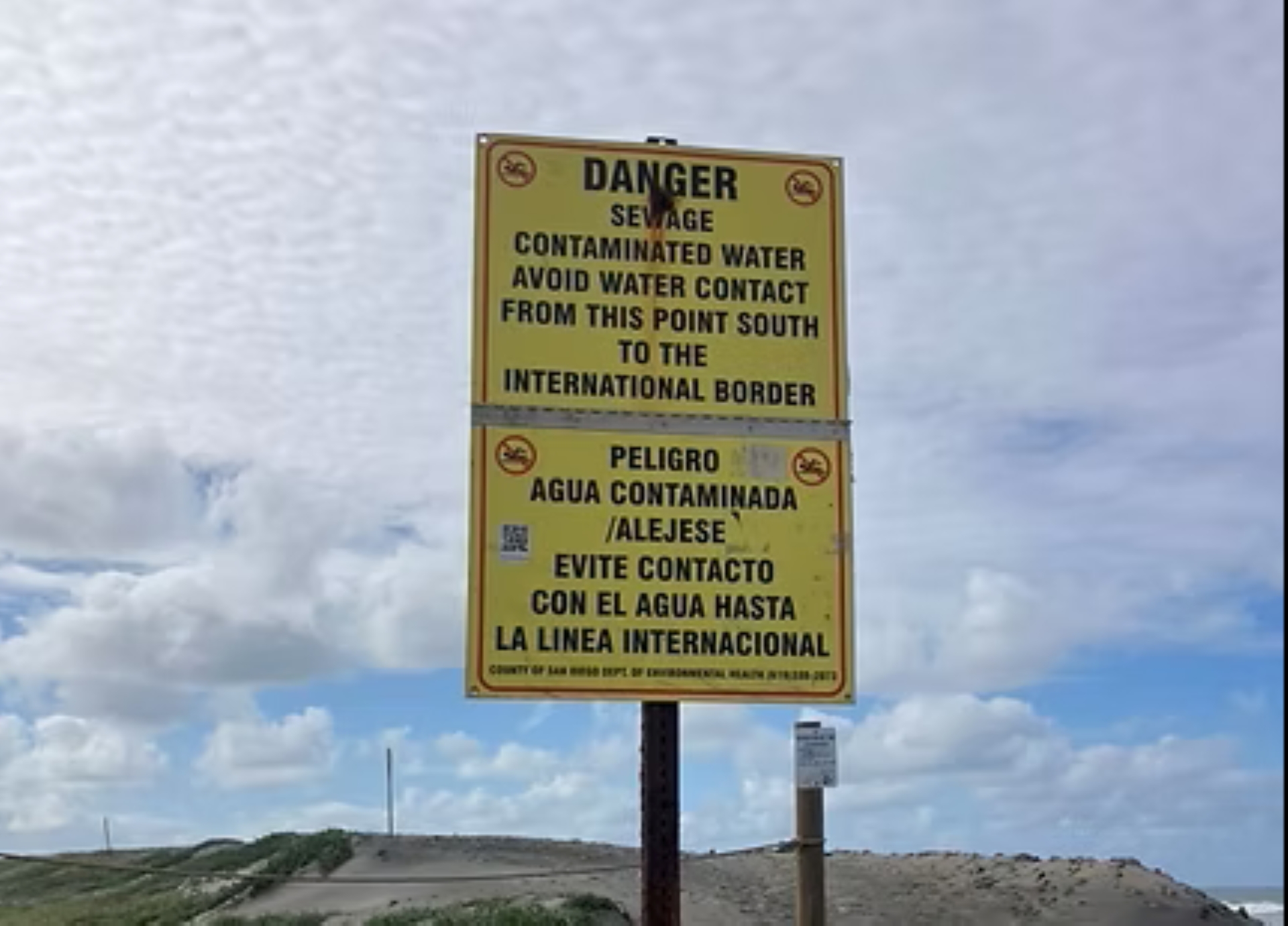
A federal facility called the South Bay International Wastewater Treatment Plant, operated by the International Boundary and Water Commission in San Ysidro, is supposed to treat the river’s flows before they reach the ocean. But for years, the plant has not been able to handle the volume. The result has been repeated beach closures, respiratory complaints from nearby residents, and what state officials now call a full-blown public health crisis.
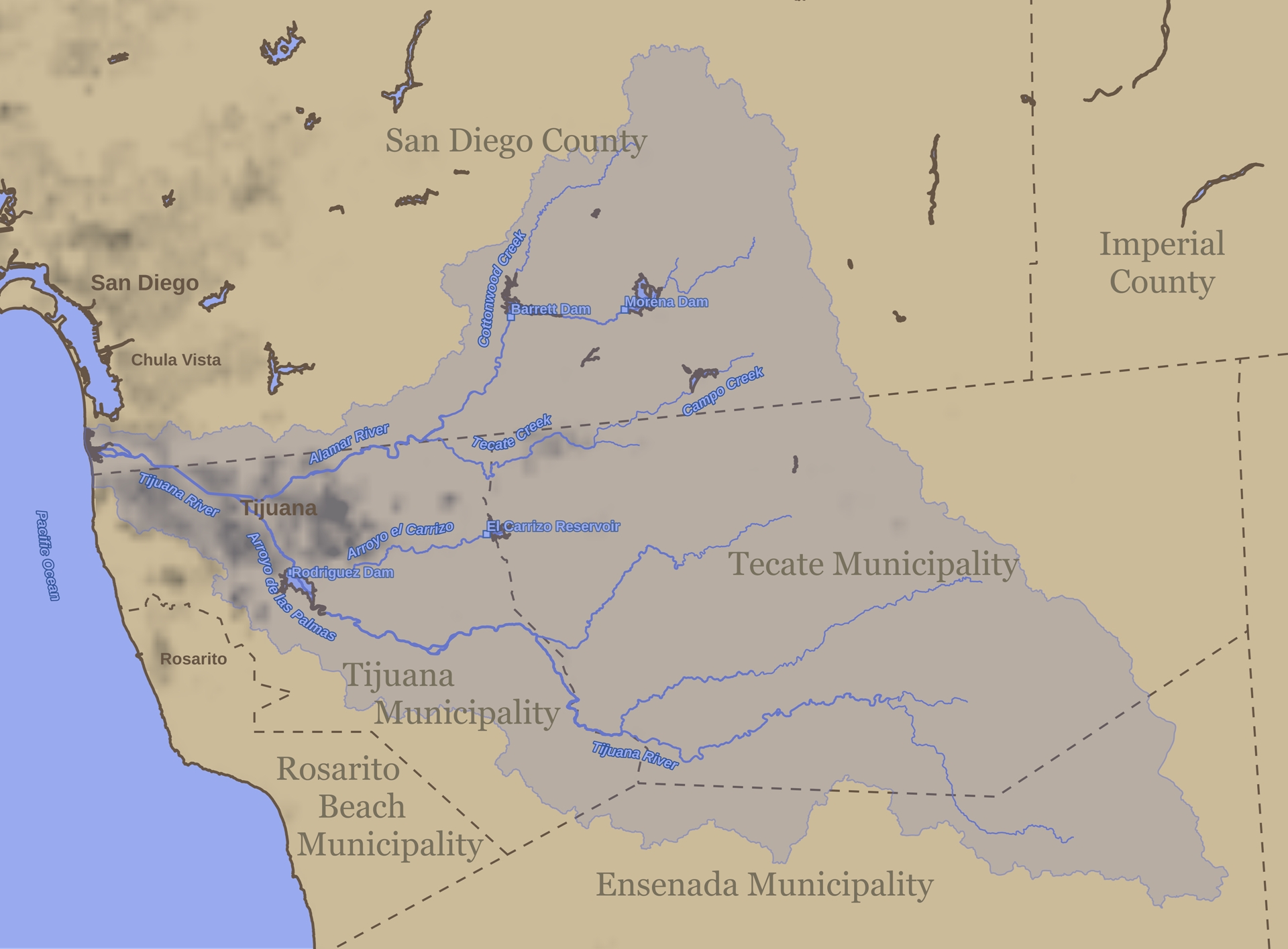
 using USGS data for river shapes. Some labels may not be entirely accurate to the names used for certain rivers and creeks, prepared April 20, 2021 by Geobica. Licensed under the Creative Commons Attribution-Share Alike 4.0 International license.
California Opens $46 Million in Grants.
On June 11, 2026, Governor Gavin Newsom announced that $46 million in funding approved by California voters under Proposition 4, formally titled the Safe Drinking Water, Wildfire Prevention, Drought Preparedness, and Clean Air Bond Act, was now available to eligible projects addressing cross-border water pollution.
The State Water Resources Control Board opened the grant application period the same day. Projects that reduce bacteria or trash loads, address public health issues tied to transboundary pollution, support habitat restoration, or manage sediment will compete for the funding. At least one project from each river, the Tijuana River and the New River, will be selected.
The maximum grant for a planning or research project is $750,000. Implementation projects can receive up to $10 million, and up to $20 million with approval from the State Water Board’s deputy director. No more than $3 million in total will go to planning or research. Applications will be accepted through August 31, 2026.
The new $46 million builds on roughly $38 million California had already committed since 2019 for projects including sediment basin maintenance, trash interception, air purifiers for affected neighborhoods, and a coastal pathogen forecasting model.
“People in San Diego County shouldn’t have to worry about getting sick, losing access to their beaches, and living with polluted air,” Governor Newsom said in the announcement. “California has stepped up repeatedly, but we can’t solve a decades-long federal failure on our own. The Trump administration must do its part, honor its commitments, and finally deliver the lasting solutions this community deserves, and they have a moral obligation to provide.”
The governor’s announcement also renewed pressure on the Trump administration to repair and expand the South Bay International Wastewater Treatment Plant, which the state describes as the federal government’s responsibility. Newsom traveled to Washington, D.C. in May 2026 to press the case directly with Environmental Protection Agency Administrator Lee Zeldin, who had pledged a “100% solution” in July 2025. As of the June 11 announcement, no permanent fix had been delivered.
The Price Tag on a Crisis: A New Study Wants Answers.
Numbers tell part of the story. Beach closures, tourism losses, declining property values, and public health costs all add up. But until now, no one has put a hard dollar figure on what the Tijuana River sewage crisis has cost the San Diego region.
That is changing. Last week, San Diego County’s Health and Human Services Agency announced an effort to gather public input for the Tijuana River Sewage Crisis Economic Impact Study. The study is focused on understanding the economic consequences of the crisis for the Tijuana River Valley and surrounding communities.
“Data can show important trends, but it does not always capture the full human and community impact of the sewage crisis,” the study website states. “Community perspectives are a critical part of making the study more accurate and more useful.”
The study is looking at impacts on jobs, businesses, tourism, property values, schools, recreation, and costs absorbed by households, government agencies, and community organizations. Residents, workers, business owners, visitors, and community groups are all encouraged to participate. Responses will remain confidential and reported only in aggregate form.
The study is separate from an epidemiological study that San Diego County has also commissioned. Officials say the goal of the economic impact study is to build an evidence base that can help guide future funding and mitigation decisions.
 .
.Tijuana Takes a Step, Too.
The crisis is not only a U.S. problem. On June 23, 2026, according to a report by Eric Sanchez published in San Diego Red, Tijuana’s City Hall approved a formal measure calling on Mexico’s National Water Commission, known as Conagua, to carry out immediate cleaning and maintenance work along the Tijuana River channel and the adjacent Alamar River bed.
According to the San Diego Red report, the measure was introduced by city councilmember Miguel Loza, who said the deteriorating condition of both waterways reflected years of neglect. The channels serve a critical flood-prevention function during heavy rain events, and failure to maintain them, Loza warned, poses serious risks to public safety.
“This is not about politics or party lines. It is a reality that affects us all and one that thousands of Tijuana residents witness every day: tires, plastic bags, mattresses, construction debris, and even discarded refrigerators,” Loza was quoted as saying in the San Diego Red report.
The measure also calls for an ongoing coordination structure between Tijuana’s city government and relevant state and federal authorities on the Mexico side, so that maintenance efforts become routine rather than reactive.
A Landmark International Agreement.
The push for federal action has not come only from government offices. Environmental advocates have played a significant role.
The Tijuana River ranked second on American Rivers’ 2025 Most Endangered Rivers list, a designation developed alongside the Surfrider Foundation and a community group called Un Mar de Colores. According to American Rivers, that listing helped bring about a meeting between the advocacy groups and Environmental Protection Agency Administrator Zeldin. The organization credits that process with helping build momentum for a landmark agreement between the United States and Mexico to address the ongoing public health crisis at the river.
Background reporting by Western-Water.com in October 2025 documented the framework behind that agreement. A Memorandum of Understanding signed in July 2025 by Administrator Zeldin and Mexico’s Environment Secretary established three main goals: securing Mexico’s financial participation, speeding up project delivery, and adding capacity to handle future population growth in the Tijuana region. A joint task group that followed the agreement identified specific construction projects where timelines could be shortened, collectively cutting an estimated 12 years from the overall build-out schedule.
An Experimental Treatment and a Political Twist.
While government agencies have pursued long-term infrastructure fixes, at least one private company tried a different approach, and its story has taken an unexpected turn.
MacKenzie Elmer, writing in Voice of San Diego on June 22, 2026, reported that Greenwater Services, a company based in Ohio, received a $2.5 million no-bid federal contract from the International Boundary and Water Commission to test experimental water treatment technology on the Tijuana River. The technique involves firing tiny, aerosolized bubbles of ozone gas into the water to destroy bacteria and other contaminants, a process known as nanobubble treatment (see related Western-Water.com report).
According to the Voice of San Diego report, Greenwater executives said in a March interview that their experiment eliminated 91.5 percent of potentially contaminating bacteria in the river.
“What happens is when these ozone bubbles burst… the ozone will attack the biology whether it’s algae or toxins,” Chas Antinone Jr., the company’s chief operating officer, told Voice of San Diego.
The experiment was not without complications. An October 2025 storm swept away the company’s equipment trailers and effectively ended the trial. Environmental groups also raised concerns about the project’s transparency. Phillip Musegaas, executive director of San Diego Coastkeeper, told Voice of San Diego: “This project had very little transparency and we raised valid concerns about the potential air quality impacts because of chemicals in the river.”
The same company also won a $1.7 million no-bid contract to install a water purification system in the Lincoln Memorial Reflecting Pool in Washington, D.C., according to the Voice of San Diego report, which cited coverage by The New York Times. That project has drawn scrutiny after the pool turned green with algal blooms.
Investigative reporting cited in the Voice of San Diego article identified the company’s ultimate owner as John J. Cafaro, described as a donor to former President Donald Trump and a neighbor to Mar-a-Lago, the president’s private club in Florida. The Voice of San Diego report noted that Cafaro pleaded guilty in 2001 to conspiracy to bribe an Ohio congressman and later testified against him. Greenwater Services declined to comment further on the reflecting pool situation, according to Voice of San Diego.
Greenwater chief executive Al George told Voice of San Diego the company hoped to expand its work and was in discussions about potentially addressing water quality issues in Lake Okeechobee in Florida and possibly the Everglades.
The Long Road Ahead.
The Tijuana River crisis did not develop overnight. It has been building for decades as Tijuana’s population grew faster than its water and sewage infrastructure could keep pace. The path to a permanent fix runs through two national governments, multiple agencies on both sides of the border, limited budgets, and communities that have been waiting a very long time.
What is clear from the activity of the past two weeks is that pressure is building from multiple directions at once. California is writing checks. San Diego researchers are counting costs. Tijuana’s own elected officials are demanding action from their federal government. Environmental advocates are claiming credit for pushing an international agreement. And questions are swirling around a no-bid federal contract tied to a politically connected company.
What remains to be seen is whether all of that activity translates into cleaner water.
Western-Water.com will continue to monitor developments related to the Tijuana River and border water quality.
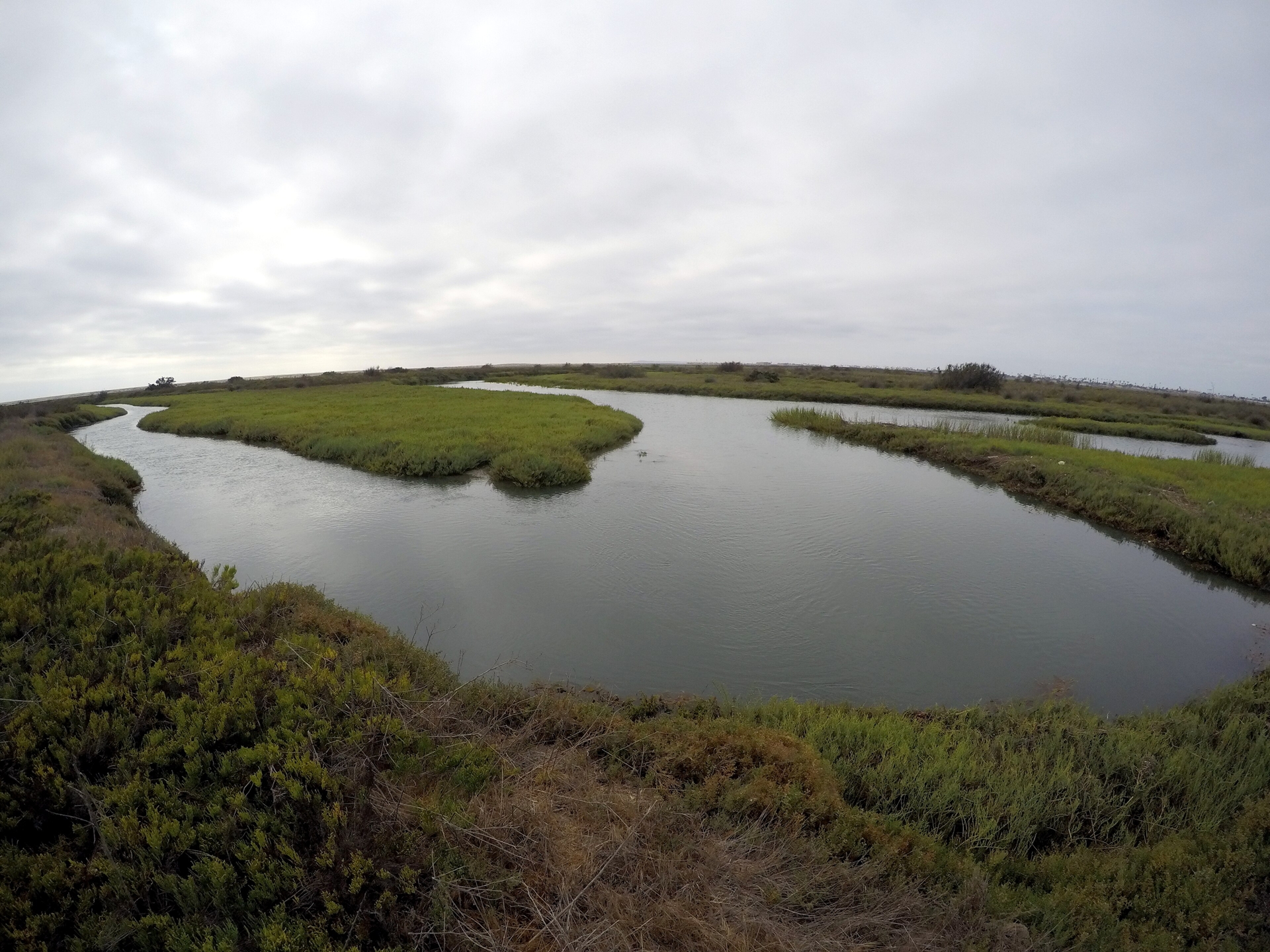
Pictured at the Top: Tijuana River, Border Field State Park, CA , by Wasquewhat, August 2018. Licensed under the Creative Commons Attribution-Share Alike 4.0 International license.