- Grand Valley Water Users Association irrigation deliveries have stopped as river flows fall too low.
- The Association says its junior water right leaves it behind senior users when natural river flows decline.
- Green Mountain Reservoir storage fell by more than 10,000 acre-feet between late July and September 4.
- Blue Mesa Reservoir is projected to end the 2026 water year at just 17 percent of live capacity.
- Federal officials have reduced Gunnison River baseflow targets during severe drought conditions.
Saturday, September 5, 2026 — Colorado’s difficult 2026 water year is showing up in reservoirs, rivers and irrigation canals across the western part of the state.
In the Grand Valley, declining river flows have reached the point where the Grand Valley Water Users Association can no longer deliver irrigation water through the Government Highline Canal. Farther upstream, federal reservoir data show falling storage at Green Mountain Reservoir. In the Gunnison River Basin, the Bureau of Reclamation says extreme drought is affecting operations at the Aspinall Unit and Blue Mesa Reservoir.
Together, the developments show how dry conditions are affecting different parts of Colorado’s water system as summer comes to an end.
Grand Valley Irrigation Water Runs Short.
The Grand Valley Water Users Association announced September 3  that it was drawing down the Government Highline Canal as river flows continued falling to levels too low for delivery.
The Association had warned irrigators on August 27 that reservoir storage water was being depleted and the canal was expected to reach an undeliverable flow on September 3. Water users were instructed to close turnouts, protect pumps and other private infrastructure, and not draw water until another official notice was issued.
Some monsoonal moisture had reached the Grand Valley by September 3, providing at least some hope that conditions could improve.
If that moisture increases flows from creeks and tributaries enough to bring the river back to a sustainable level, the Association said it intends to recharge the canal and resume deliveries.
“Fingers crossed that will be soon!” the Association said in its September 3 update.
Mesa County Irrigation District also agreed to stop its deliveries on September 3. Its senior water right was being used to help keep laterals charged so deliveries could restart more quickly if river flows improve.
Why Some Irrigators Still Have Water.
The uneven availability of irrigation water in the Grand Valley largely stems from Colorado’s system of prior appropriation, which determines who receives water first when supplies become limited, the Grand Valley Water Users Association explained the situation in an August 19 update.
Grand Valley Irrigation Company holds the senior right and is entitled to the first 520 cubic feet per second in the river. Palisade Irrigation District and Mesa County Irrigation District follow with a combined right of 120 cubic feet per second. Orchard Mesa Irrigation District has a 460-cubic-feet-per-second right, although its operations involve a more complicated arrangement in which water is delivered for hydroelectric pumping and returned to the river.
The Grand Valley Water Users Association has a right to 730 cubic feet per second, but its right is junior to the others.
That means the Association is last in line among the entities described in its August update when natural river flows are insufficient to satisfy all rights.
The Association emphasized that the current loss of water does not necessarily mean irrigation deliveries are finished for the year. It plans to recharge the canal and laterals when water becomes available and said operations could continue into November, depending on water availability, temperatures and demand.
Supplemental Water Has Been Used Up.
The Grand Valley problems did not arrive without warning.
By August 15, substitution water being used to supplement stream flows from Williams Fork and Wolford had been depleted. The Association then relied on other water secured from several entities, with much of that supply coming from Ruedi Reservoir and additional water coming from Granby.
The Association warned on August 19 that, without significant monsoonal moisture, supplemental water would likely end around September 3.
Once that supplemental water was exhausted, irrigation supplies would depend much more heavily on what was naturally flowing in the river and on the priority of individual water rights.
Green Mountain Reservoir Storage Falls.
Federal data show declining storage elsewhere in Colorado.
According to provisional Bureau of Reclamation figures, Green Mountain Reservoir held 21,812 acre-feet of water on September 4. The reservoir elevation was 7,840.77 feet.
On July 29, storage had been 32,080 acre-feet.
That represents a decline of 10,268 acre-feet in a little more than five weeks.
On September 4, estimated inflow was 121 cubic feet per second while total releases were 252 cubic feet per second. The Bureau of Reclamation notes that the figures are provisional and subject to review and modification.
Blue Mesa Forecast at 42 Percent of Average.
Conditions are also very dry in the Gunnison River Basin.
As of September 3, the Bureau of Reclamation estimated the 2026 water-year unregulated inflow into Blue Mesa Reservoir at 377,000 acre-feet, or 42 percent of average.
For the April-through-July water supply period, unregulated inflow was forecast at only 155,000 acre-feet, or 24 percent of average.
Reclamation said Blue Mesa will not fill in 2026.
Current projections call for the reservoir to finish the water year at an elevation of 7,412.01 feet with approximately 140,000 acre-feet in storage. That would equal about 17 percent of the reservoir’s live capacity.
August unregulated inflow into Blue Mesa totaled about 16,000 acre-feet, or 27 percent of average.
Forecasts remain below average for the next several months. Reclamation projected September inflow at 49 percent of average, October at 58 percent and November at 61 percent.
Drought Changes Gunnison River Operations.
The dry conditions are also affecting the management of water downstream of the Aspinall Unit.
As of September 3, releases from Crystal Dam were approximately 1,245 cubic feet per second. Gunnison River flows through the Black Canyon were near 245 cubic feet per second, while flows in the Whitewater Reach were approximately 820 cubic feet per second.
Under operating rules adopted in 2012, baseflow targets can be reduced during severe drought.
In consultation with the U.S. Fish and Wildlife Service, Reclamation reduced the September 2026 baseflow target at Whitewater to 500 cubic feet per second. The agency said the change was made to conserve reservoir storage while preserving an instream flow consistent with the authorized purposes of the Aspinall Unit.
A Difficult End to Colorado’s Water Year.
The conditions vary from one river, reservoir and irrigation system to another, but the September reports document significant water-supply challenges across western Colorado.
In the Grand Valley, junior irrigation water users are waiting for river flows to recover enough to restart deliveries. At Green Mountain Reservoir, storage has been declining. At Blue Mesa, inflows remain well below average and storage is projected to continue falling through the end of the water year.
For Grand Valley irrigators, the immediate question is whether monsoonal moisture and tributary flows can provide sufficient water to restore the Government Highline Canal to operation.
The Grand Valley Water Users Association has told irrigators it intends to resume water deliveries if sustainable flows return. Until then, users have been instructed to keep their turnouts closed and wait for authorization from their ditch riders.
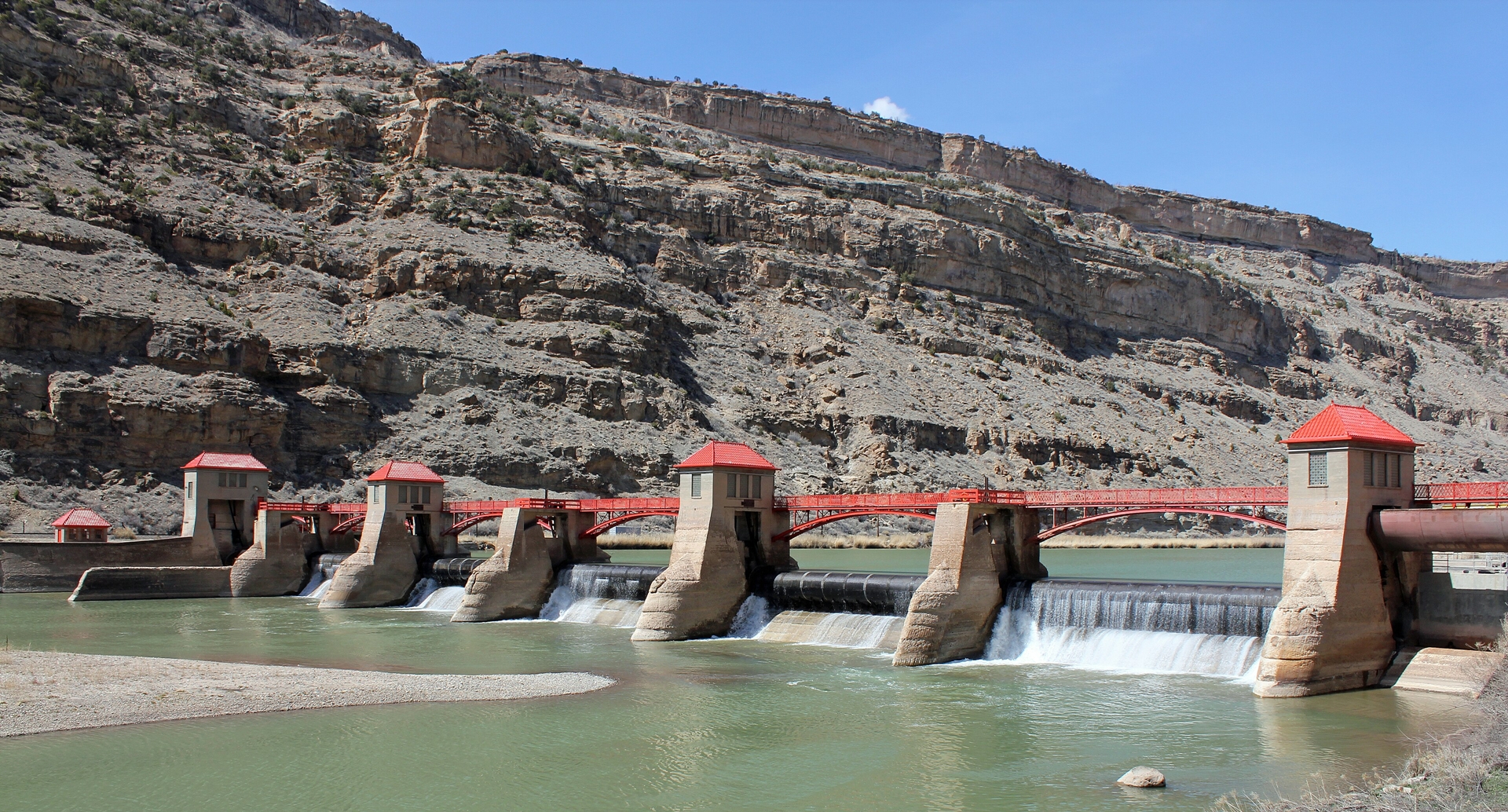
Pictured: The Grand Valley Diversion Dam , located on the Colorado River in Mesa County, Colorado, March 2013, by Jeffrey Beall. Licensed under the Creative Commons Attribution 3.0 Unported license.