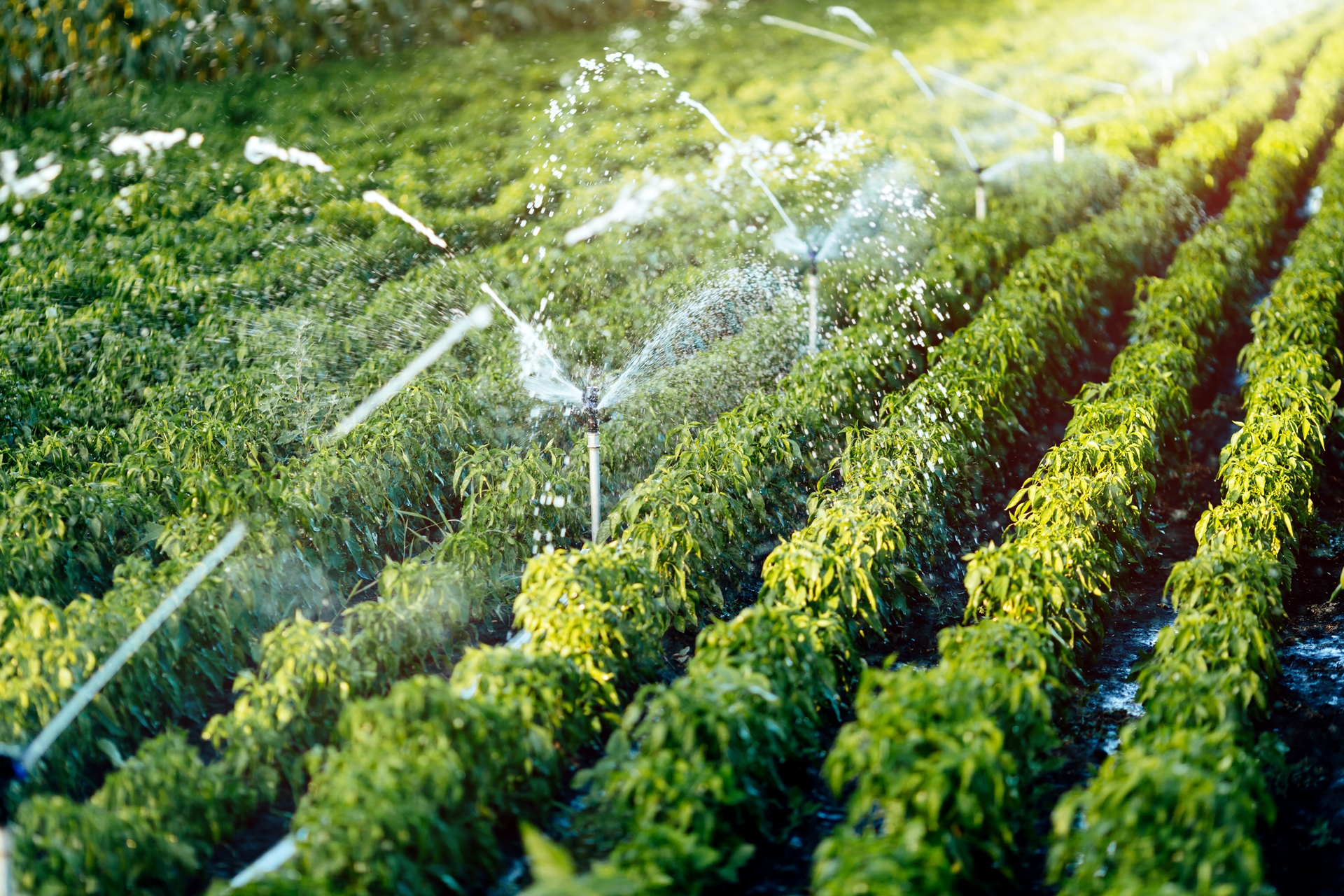
- U.S. irrigation increases crop production while limiting the need for more farmland.
- Researchers estimated that avoided land conversion prevents 6.86 gigatons of greenhouse gas emissions.
- That benefit is 363 times greater than the direct annual emissions attributed to irrigation.
- Pumping water is the largest source of irrigation-related greenhouse gas emissions.
- Researchers cautioned that irrigation also involves broader water-use trade-offs, especially in the West.
Thursday, September 17, 2026 — Irrigation is often discussed in the West in terms of how much water it consumes. New research from Colorado State University adds another piece to that discussion: how irrigation affects greenhouse gas emissions.
The study found that irrigated agriculture produces greenhouse gas emissions of its own, particularly from the energy used to pump and move water. But irrigation also allows farmers to grow more food on less land.
That matters because converting forests, grasslands and other natural areas into farmland can release carbon stored in plants and soil.
The researchers estimated that the land spared because of U.S. irrigation represents about 6.86 gigatons of avoided greenhouse gas emissions. By comparison, irrigation itself produces about 0.019 gigatons of direct greenhouse gas emissions each year.
That makes the estimated benefit from avoided land conversion 363 times greater than irrigation’s annual direct emissions.
What Happens Without Irrigation?
The research, published September 14 in the Proceedings of the National Academy of Sciences, looked at a hypothetical question: What would happen if U.S. crop production suddenly had to depend entirely on rainfall?
Researchers first examined agricultural data to determine how irrigation affects crop yields in individual counties. They then used a global economic model to estimate how agricultural production, consumption and trade could change without U.S. irrigation.
The study found that irrigation increases U.S. crop production by 3% to 39% depending on the crop and provides at least $31.9 billion in additional agricultural revenue.
Without those higher yields, additional land would be needed elsewhere to replace lost production.
Researchers estimated that irrigation’s productivity benefits avoid the net conversion of about 32 million hectares of forest and 7 million hectares of other natural vegetation globally. Their model also projected changes involving grasslands and croplands.
Why Land Conversion Matters.
Agriculture produces greenhouse gases in two different ways considered by the study.
Some emissions occur directly from agricultural operations. Others can occur when natural land is converted to agricultural use.
Land use and land conversion associated with producing food, fiber and fuel account for nearly one-quarter of global greenhouse gas emissions, according to the study.
Lead author Avery Driscoll, who conducted the research as a Colorado State University doctoral student, said the comparison showed a large difference between irrigation’s direct emissions and the emissions avoided through reduced land conversion.
“It was clear from this work that irrigation has a net positive effect on emissions,” Driscoll said in a Colorado State University article by Jayme DeLoss. “The avoided emissions from reductions in indirect land-use change were much greater than the direct emissions, and that could decline further with electrification.”
Pumping Water Produces Emissions.
The largest direct source of greenhouse gas emissions from irrigation is the energy needed to move water.
That includes pumps operating on farms as well as energy used to move water between river basins. When those systems rely on fossil fuels, they produce greenhouse gas emissions.
Researchers said replacing fossil fuel-powered pumps with electric equipment could reduce those emissions. They suggested that incentives for electrification could be considered as part of climate-smart agricultural programs.
Irrigation can produce smaller amounts of emissions in other ways. Previous research by the team examined nitrous oxide released through microbial activity and carbon dioxide dissolved in groundwater that can be released when the water is sprayed onto fields.
The Study Has Limits.
The analysis did not include emissions from some other agricultural activities.
For example, it did not account for emissions associated with applying nitrogen fertilizer to crops or methane produced by livestock.
The researchers also emphasized that greenhouse gas emissions are only one part of the much larger question surrounding irrigation and water use.
That distinction is especially important in the western United States, where agriculture relies heavily on irrigation and water supplies face competing demands.
“We’re able to show this large benefit of U.S. irrigation to greenhouse gas emissions from the food system,” Colorado State University associate professor and study co-author Nathan Mueller said.
But Mueller cautioned that water use, particularly in the West, comes with trade-offs extending beyond food production and greenhouse gas emissions. He described the research as “one piece of the puzzle” in evaluating complicated decisions about water use.
A Colorado Farm Offers a Real-World Example.
The Colorado State University report also looked at what irrigation means on the ground.
Alex Brown’s family has farmed and raised livestock on the same property in Yuma County, Colorado, for 120 years. Brown said losing irrigation would leave farmers dependent on unreliable rainfall and could force less productive and more environmentally sensitive pastureland into crop production.
Brown said his family continues to adopt technology and newer equipment to improve irrigation efficiency.
“I’m very passionate about it because I’d love to see our farm continue on for generations,” Brown said about conserving water.
Irrigation, Drought and a Changing Climate.
Researchers also described irrigation as a tool that can help agriculture cope with heat and drought.
“Irrigation is a powerful adaptation strategy,” Driscoll said. “It increases productivity; it increases resilience to heat and drought stress.”
At the same time, she said maintaining agricultural production and reducing emissions are challenges that must be considered together.
The study was funded by the National Science Foundation and the AI Institute for Land, Economy, Agriculture & Forestry, which is supported by the U.S. Department of Agriculture. Researchers from Colorado State University, the University of Minnesota, U.S. Forest Service Rocky Mountain Research Station, University of Maine and The Nature Conservancy participated in the work.
Driscoll, A. W., Johnson, J. A., Blumberg, J. E., King, A. E., Spawn-Lee, S. A., & Mueller, N. D. (2026). Global greenhouse gas cobenefits of US irrigated agriculture. Proceedings of the National Academy of Sciences, 123(39), e2528170123. https://doi.org/10.1073/pnas.2528170123