
- The federal government awarded a $75.5 million contract on June 10, 2026, to push a major water pipeline project forward on Navajo lands in New Mexico.
- Nearly 10,000 feet of new pipe will be installed underground using a no-dig drilling method that protects sacred cultural sites on the surface.
- More than one in three Navajo Nation residents currently lack indoor plumbing and must haul their own drinking water home.
- The San Juan Lateral portion of the project is more than 70% complete, with first water deliveries expected by late 2028.
Thursday, June 11, 2026 — For generations, many families living on the Navajo Nation in the American Southwest have faced a daily reality that most people in the United States never think about — hauling jugs of water to their homes because there is no pipe connected to a faucet. That reality moved a step closer to ending on June 10, 2026, when the federal Bureau of Reclamation announced a $75.5 million construction contract tied to one of the largest Native American water projects in the country.
The contract goes to Flatland Energy Services LLC, a company that will tackle some of the most technically demanding underground pipe installations in the history of the Navajo-Gallup Water Supply Project in northwest New Mexico.
What Exactly Is Being Built?
The work centers on a stretch of pipeline known as the Block 2-3 segment. It begins at the Frank Chee Willetto Reservoir, roughly 17 miles east of Shiprock, New Mexico, and ends at the San Juan Lateral Water Treatment Plant — a facility currently under construction about six miles east of where U.S. Highway 491 meets Navajo Route 36 in the Hogback Chapter of San Juan County.
To connect these two points, crews will install nearly 10,000 feet of large-diameter pipe — ranging from 36 to 42 inches in diameter — through some surprisingly tricky ground.
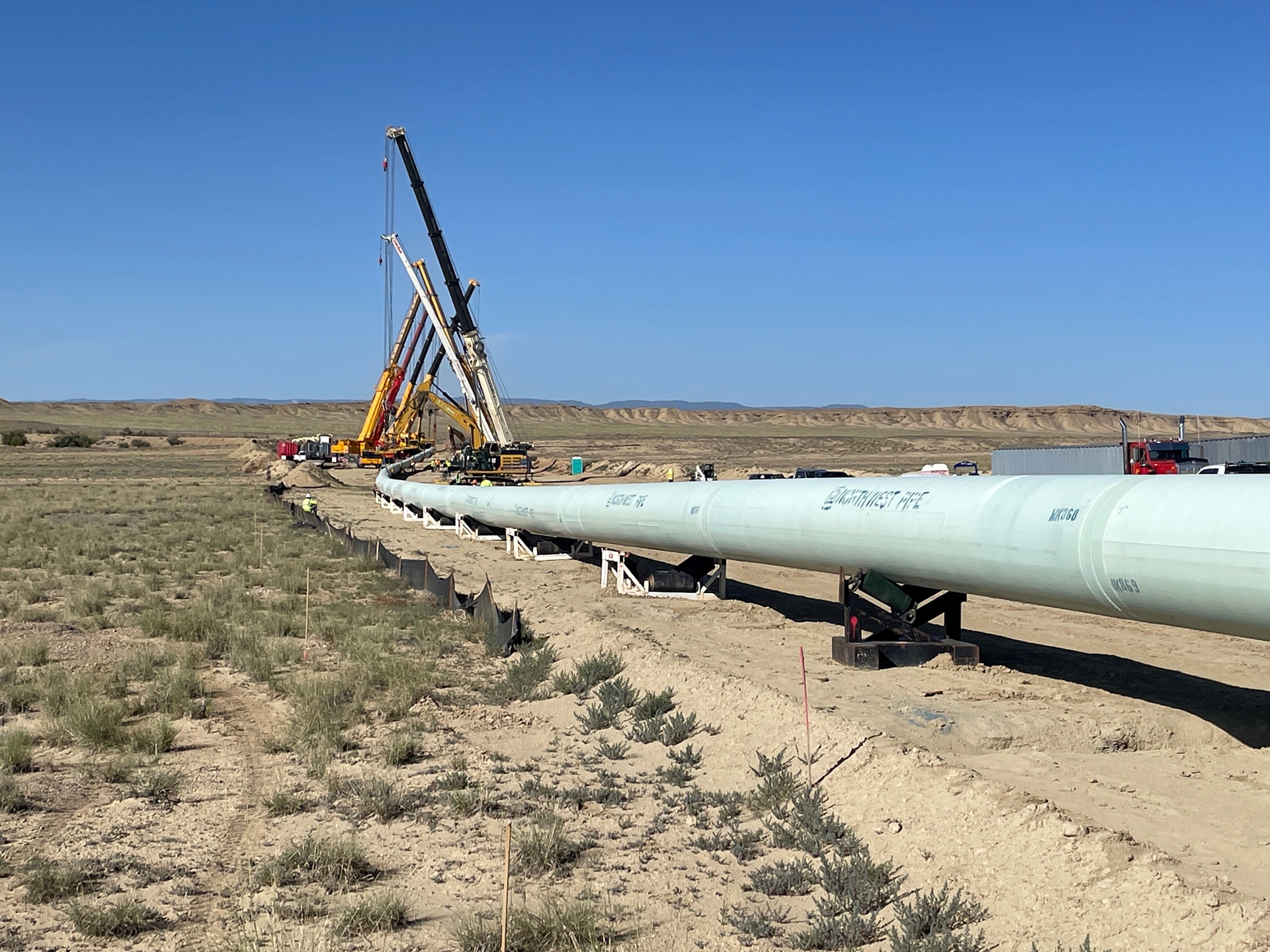
Rather than digging open trenches, the contractor will use a technique called horizontal directional drilling, or trenchless drilling. Think of it like pushing a very long straw underground without tearing up the ground above. A drilling machine bores a curved path beneath the earth, and workers then pull the pipe through the hole. The surface above stays largely undisturbed.
Four Underground Crossings, One Big Challenge.
The project calls for four of these underground crossings in the Block 2-3 section. Each one presents its own puzzle.
The pipe will pass beneath Shumway Arroyo, the San Juan River, the Chaco River, and a rugged rise in the land called Nenahnezad Hill. That last one is particularly demanding — the drill path must navigate an elevation change of about 250 feet, the equivalent of climbing a 25-story building, all while underground.
Bart Deming, the area manager who oversees the Bureau of Reclamation’s Four Corners Construction Office, explained why this approach matters beyond engineering convenience.
“This installation on Reaches 2 and 3 will allow the pipeline to cross beneath the San Juan and Chaco Rivers and avoid other challenging terrain and existing infrastructure where traditional trenching would be difficult or impractical,” Deming said on June 10, 2026.
The method also protects what lies on top. Several of these crossing areas sit near or beneath important Navajo traditional cultural sites. By keeping the drill underground, construction avoids disturbing those sacred surfaces.
Individual sections of the pipeline will run from roughly 2,000 to 3,300 feet in length, and the depth of each section will vary depending on what lies above.
More Than $143 Million Invested This Year Alone.
The new contract is not the first major financial commitment made to this project in 2026. Earlier this year, the Bureau of Reclamation announced a separate contract to construct the project’s San Juan intake facility. Combined with the June 10 announcement, the federal government has now awarded more than $143 million in contracts for the Navajo-Gallup Water Supply Project in 2026 alone.
Andrea Travnicek, the Assistant Secretary for Water and Science, put it plainly.
“With this contract, Reclamation has awarded more than $143 million in contracts to advance construction of the Navajo Gallup Water System this year,” Travnicek said. “The Trump-Vance Administration is making great progress on this important project to bring clean, reliable drinking water to the Navajo Nation.”
Construction under the new contract is expected to begin in the summer of 2026 and wrap up in the fall of 2028.
A Massive Project With a Long History.
The Navajo-Gallup Water Supply Project is not a new idea. Congress authorized it for construction in 2009 through a law known as the Omnibus Public Land Management Act, and ground was broken in 2012. More than a decade later, the project is still taking shape — a testament to both its enormous scale and its complexity.
When finished, the project will include roughly 300 miles of pipeline, two water treatment plants, 19 pumping stations, and multiple storage tanks. The water will serve communities across the Navajo Nation in both New Mexico and eastern Arizona, as well as the city of Gallup, New Mexico.
The San Juan Lateral portion of the system — which feeds off the San Juan River — is already more than 70% complete. Initial water deliveries through that portion are expected in late 2028, with the full project scheduled for completion by the end of 2029.
The project also represents the cornerstone of the Navajo Nation’s water rights settlement in the San Juan River Basin in New Mexico, a legal agreement that resolved longstanding questions about how much water the Nation is entitled to use from the river.
The Human Side of the Numbers.
Behind every contract announcement and construction milestone is a simple, urgent human need. According to the Bureau of Reclamation, more than one in three people living on the Navajo Nation do not have indoor plumbing. They collect and haul their own drinking water — a task that takes time, money, and physical effort that most Americans never have to consider.
The pipeline being built beneath arroyos, rivers, and hills is not just an engineering achievement. For many Navajo families, it represents the promise of something as basic as turning on a tap.
Image via Reclamation’s News Release: “Horizontal Directional Drill pullback method being utilized on Reach 4B near Shiprock, New Mexico on the Navajo Gallup Water Supply Project in June 2025. This type of pullback will be used for construction of the Block 2-3 Pipeline which begins at the Frank Chee Willetto Reservoir approximately 17 miles east of Shiprock, New Mexico, and ends at the San Juan Lateral Water Treatment Plant.”