- Colorado Governor Jared Polis signed House Bill 26-1340 into law on June 1, 2026.
- More than 100,000 acres of irrigated farmland in Colorado’s Arkansas River Basin have been permanently dried up to supply water to growing cities.
- A Colorado State University study estimates annual economic losses between $1,439 and $1,601 for every acre taken out of irrigation.
- The new law requires water rights owners to restore dried-up land through revegetation or conversion to dryland farming before fully using transferred water.
- A third-party expert appointed by water courts will conduct annual field reviews to track revegetation progress.
Saturday, June 20, 2026 — For generations, the Arkansas Valley in southeastern Colorado was farm country. Fields of alfalfa and other crops stretched across the landscape, fed by water rights that had been passed down through families for over a century. Then the cities came knocking.
Starting decades ago, growing municipalities along Colorado’s Front Range began purchasing those water rights and moving the water away from farms to supply residents far from where it originated. The practice, known as “buy-and-dry,” has stripped more than 100,000 acres of irrigated farmland in the Arkansas River Basin of the water that kept it alive, according to the Lower Arkansas Valley Water Conservancy District .
.
The land left behind has not fared well. In Crowley County, productive farmland has declined by more than 90 percent since the 1970s, according to Rocky Mountain PBS. What remains is largely bare ground, blowing dust, invasive weeds, and eroded soil.
“Too often, the land left behind has become a burden on neighboring landowners and rural communities, contributing to blowing dust, invasive weeds, erosion, fire risk, and public safety concerns,” the Lower Arkansas Valley Water Conservancy District said in a May 14, 2026 statement.
The Numbers Behind the Loss.
The environmental damage is visible. The economic damage, it turns out, is also measurable.
A May 2026 report from Colorado State University’s Regional Economic Development Institute, authored by Yvette Uwineza, Rebecca Hill, and Jordan Suter, put hard numbers to what many in the valley already felt. Researchers found that between 1978 and 2022, five counties in the Lower Arkansas River Valley, namely Bent, Crowley, Otero, Prowers, and Pueblo, lost more than 120,000 irrigated acres. That works out to roughly 3,043 acres every single year.
The financial toll is significant. Depending on which crops are lost, the study estimates that each acre removed from irrigation costs the regional economy between $1,439 and $1,601 per year. When multiplied across the average annual loss, that adds up to somewhere between $4.38 million and $4.87 million in annual economic damage to the region. Those figures include not just farm income, but the ripple effect on local businesses, suppliers, and service providers who depend on a working agricultural economy.
The report notes that crop composition matters. When alfalfa production, one of the valley’s most valuable crops, makes up a larger share of what is lost, the economic damage is higher.
A New Law With Real Teeth.
On June 1, 2026, Governor Polis signed House Bill 26-1340 into law, establishing clear obligations for anyone who purchases agricultural water rights in Water Division 2, which covers the Arkansas River Basin, and moves that water to a different use on or after January 1, 2027.
The bill had broad, bipartisan support, sponsored by Representative Ty Winter, a Republican, along with Representative Tisha Mauro, Senator Rod Pelton, and Senator Nick Hinrichsen.
Under the new law, a water rights owner who transfers agricultural irrigation water to another use must either revegetate the formerly irrigated land with native plant cover or convert it to dryland farming that includes effective erosion control and weed management. The law does not apply to land where water rights were already severed from the property in previous transactions.
To make sure the work actually gets done, the law creates an enforcement structure. Water courts must appoint a neutral, third-party expert who will visit the land each year and report on whether revegetation or dryland farming efforts are succeeding. In the meantime, courts can limit how much of the transferred water the new owner can actually use until the land is restored. Alternatively, owners may be required to post a financial bond to cover reclamation costs if the work falls short.
“The act requires a water right owner that changes the use of their water right in water division 2 from agricultural irrigation purposes to another beneficial use on or after January 1, 2027, to engage in revegetation or a conversion to dryland farming with effective erosion control and weed management on the formerly irrigated agricultural land,” the Colorado General Assembly summarized in the bill’s official description.
The law also strengthens the role of local county governments by requiring water courts to incorporate county-level revegetation standards directly into change-of-use decrees.
Filling a Gap in a 30-Year-Old Rule.
Colorado has technically required revegetation provisions in water transfers since 1992. However, as Jack Goble, general manager of the Lower Arkansas Water Conservation District, told Rocky Mountain PBS, the older law never clearly defined what successful revegetation looked like, and it left enforcement largely to individual landowners who often lacked the resources to pursue legal action in water court.
The comparison Goble draws is straightforward. According to Rocky Mountain PBS, he noted that industries such as coal, gravel, and oil and gas are required to reclaim land after extraction and argued that water transfers should carry the same responsibility.
One practical challenge facing anyone trying to revegetate former farmland is that more than a century of irrigation changes the soil in ways that make it hard for plants to grow without water. The new law addresses this by allowing water rights owners to retain some limited irrigation use while revegetation is being established.
Cities, Growth, and What Comes Next.
The biggest municipal water users in the Arkansas Valley are watching the law carefully. Aurora Water, which receives roughly a quarter of its water supply from the Arkansas River, according to Rocky Mountain PBS, said it supports the general intent of the legislation and pointed to revegetation agreements it had previously established in the region.
However, Aurora Water expressed concern about the law expanding beyond Water Division 2 to other parts of Colorado, citing potential complications for existing dryland farming operations and the importance of allowing water courts to evaluate revegetation requirements based on the specific facts of each case.
In 2024, Aurora Water announced an $80 million purchase of farmland in Otero County that allows the utility to divert water from the Arkansas River three out of every 10 years, according to Rocky Mountain PBS. That kind of flexible arrangement is seen by some as a step toward reducing the all-or-nothing nature of traditional buy-and-dry deals.
The Lower Arkansas Water Conservation District has been pushing for another alternative altogether: water leasing. Under that model, farmers would temporarily lease a portion of their water allotment to cities rather than selling it outright, keeping ownership of the underlying right and preserving the ability to irrigate their land during the years the lease is not in effect.
According to Rocky Mountain PBS, Goble described the idea simply: instead of selling the whole asset, farmers sell its output on a recurring basis, retaining the underlying resource for themselves.
A Turning Point for the Valley.
The signing of House Bill 26-1340 represents a meaningful shift in how Colorado treats the land left behind after water leaves. For communities in the Arkansas Valley that have watched productive farmland turn to dust over decades, the law does not undo past damage. But supporters say it draws a clear line about what future water transfers will require.
“The Lower Arkansas Valley Water Conservancy District thanks our prime bill sponsors Representative Ty Winter, Representative Tisha Mauro, Senator Rod Pelton, and Senator Nick Hinrichsen for their leadership and bipartisan commitment in advancing HB26-1340 through the Colorado General Assembly,” the district said in its May 14, 2026 statement.
The law takes effect January 1, 2027.
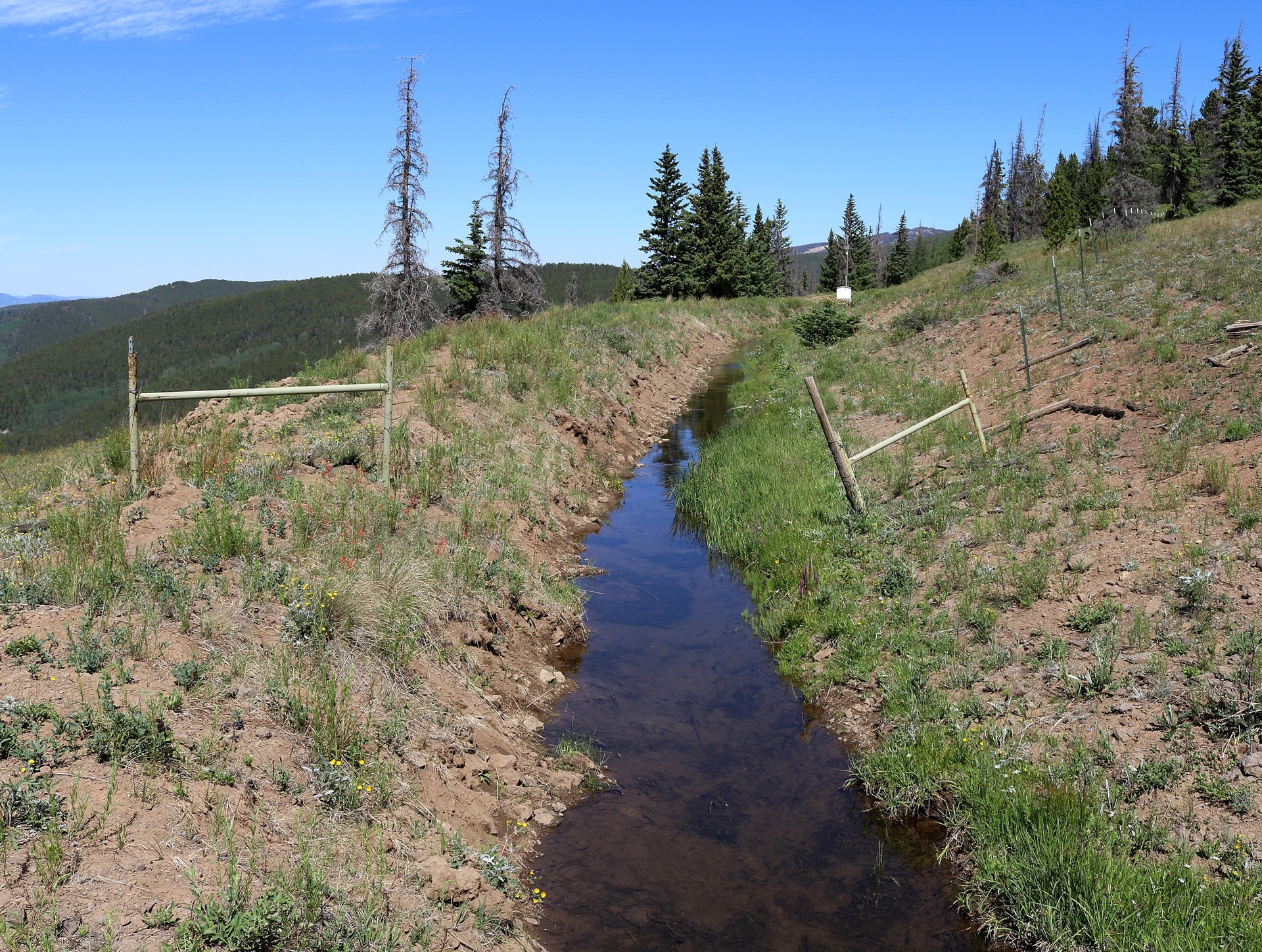
Pictured: The Larkspur Ditch at Marshall Pass . The ditch brings water from the Colorado River watershed to the Mississippi River watershed through a ditch that crosses Marshall Pass. The ditch is mostly owned by the Lower Arkansas Valley Water Conservancy District. Jeffrey Beall, July 2020. Licensed under the Creative Commons Attribution 4.0 International license.