- New Mexico regulators say the lab has ignored February demands to halt the spreading chromium plume.
- The state fined the Los Alamos National Laboratory $6 million for permit and water standard violations.
- The contamination crossed onto San Ildefonso Pueblo land last November but sits away from known drinking water wells.
- State and federal officials remain split over how to treat the polluted water once it is pumped from the aquifer.
- The Energy Department wants to reinject the treated water, while the state pushes for other disposal methods.
Wednesday, August 19, 2026 –– New Mexico environmental regulators told state lawmakers this week that the Los Alamos National Laboratory has not met February demands to stop the spread of a large underground chromium plume, a problem that traces back decades.
Source New Mexico reports that the New Mexico Environment Department fined the federal laboratory $6 million earlier this year, saying it violated state water standards and the terms of a discharge permit. Chromium, once used in the lab to prevent cooling tower pipes from rusting, was flushed into Sandia Canyon between 1956 and 1972 and later detected in groundwater in 2005. Officials announced last November that the contamination had crossed onto San Ildefonso Pueblo land, though both state and federal leaders say it does not threaten any known drinking water wells for now. Santiago Rodriguez of the Environment Department described the situation as an impasse, noting that the state and the U.S. Department of Energy still disagree on how to treat the water once it is pumped from the aquifer. The federal department wants to reinject the treated water, pointing to a 980-page independent report from December 2024 that lists restarting injection as its top recommendation. State officials counter that reinjection pushes the plume forward and have urged the federal government to consider other options, such as spraying the treated water onto the surface so it can slowly soak back in. The state lawsuit does not name a preferred fix, but it presses federal officials to produce a plan quickly.
Details are in Source New Mexico’s report below, published under the Creative Commons license CC BY-NC-ND 4.0 license.
New Mexico officials say they’re still at an ‘impasse’ with feds over spreading chromium plume
by Patrick Lohmann, Source New Mexico
August 14, 2026
New Mexico Environment Department officials said this week that the Los Alamos National Laboratory has not complied with its February demands aimed at quickly and safely stopping the spread of a massive underground chromium plume that recently reached the boundaries of a nearby Pueblo.
The NMED in February issued a $6 million fine against LANL, asserting the federal laboratory had failed to comply with state water standards and the terms of a discharge permit related to its handling of the decades-old plume of chromium. The toxic chemical can increase risk of certain cancers after long-term ingestion.
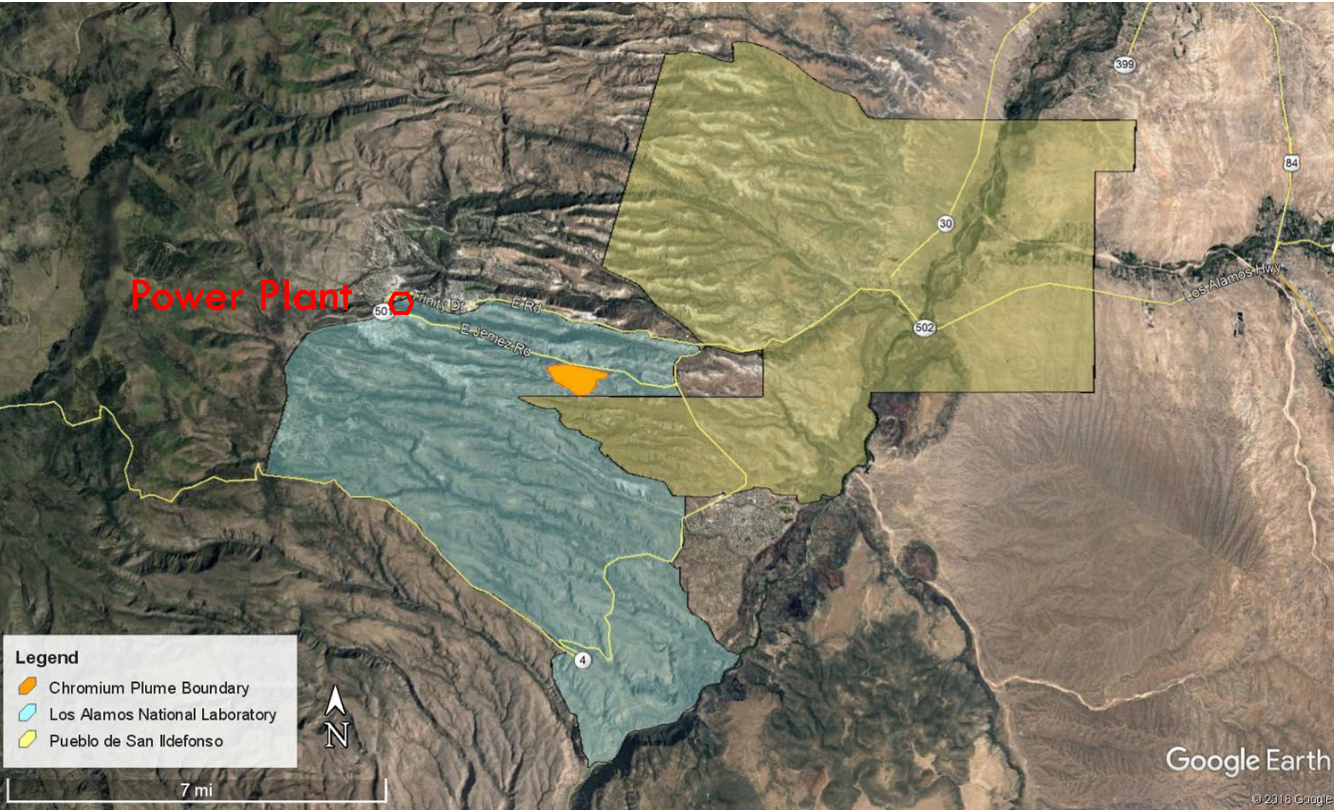
Lab workers historically used chromium as a way to prevent pipes from rusting in a power plant’s cooling towers and then periodically flushed chromium-contaminated water down Sandia Canyon between 1956 and 1972. The plume was discovered in the groundwater supply in 2005.
Since then, how to mitigate the plume has been the subject of ongoing and sometimes contentious debate between state and federal officials, namely the Environment Department and the U.S. Department of Energy.
In the meantime, the plume has continued to spread. State officials announced in November that the chemical spill had spread beyond LANL property to San de Ildefonso Pueblo land.
Federal and state officials have stressed that the plume’s spread does not pose imminent threats to drinking water in the Pueblo or in Los Alamos County because it is not near any known private or public wells.
Santiago Rodriguez, deputy director of NMED’s Resource Protection Division, told lawmakers on the interim Radioactive and Hazardous Materials Committee on Thursday that NMED and LANL are still at an “impasse.” The state and federal governments still differ on the best way to treat the contaminated water once it’s been pumped from the aquifer, among other disagreements, he said.
NMED officials contend the treated water should not be reinjected into its original aquifer, saying doing so actually propels the plume forward. They are urging the federal agency and laboratory to come up with alternative measures.
LANL officials stopped attending regular workshops between the Pueblo, state agencies and Los Alamos County shortly after the February lawsuit, Rodriguez said. The workshops were aimed at placing “key decision makers and impacted parties together in one room to discuss and develop plans for a path forward,” he said.
Stephanie Gallagher, a DOE spokesperson, told Source NM on Friday that the department was working on a response to Source NM’s questions regarding the Thursday meeting.
Lawmakers request feds and state officials find third party in chromium plume fight
However, the department has held its own public meetings in recent months and also continued to pressure NMED to allow it to resume reinjecting treated water back into the aquifer. In late June, the DOE issued a statement arguing that injecting the treated water should begin as soon as possible.
“Groundwater well sampling data shows that the [reinjection] has a positive effect,” the June 25 statement reads. “Injection establishes a hydraulic barrier in the area of injection, which helps to control and reduce the plume, while also preserving aquifer water, a precious natural resource.”
The DOE also cites recommendations from an independent research team’s 980-page report, released December 2024, that says its “single most important recommendation” is to restart injections while other studies and investigations move forward.
Still, NMED officials have pushed the DOE to find alternative uses for the water once the chromium is removed, while also ordering them to pump a minimum of 170,000 gallons per day of contaminated water.
One possible alternative the NMED has pointed to is to “land apply” the treated water, which would mean allowing the treated water to more gently reabsorb into the aquifer by spraying or sprinkling it onto the surface. The NMED’s lawsuit does not identify a preferred alternative to injection but instead seeks to spur federal officials to come up with a plan as soon as possible.
“We are using the tools that we have to hold them accountable,” Justin Ball, chief of the NMED’s Ground Water Quality Bureau, told lawmakers Thursday. “To me, it’s shocking that a world-renowned research institution can’t think of alternative options for disposing of this water, and that they, frankly, won’t even seem to consider alternative options.”
Source New Mexico is part of States Newsroom, a nonprofit news network supported by grants and a coalition of donors as a 501c(3) public charity. Source New Mexico maintains editorial independence. Contact Editor Julia Goldberg for questions: info@sourcenm.com. Image from Source New Mexico: A depiction of the Los Alamos National Laboratory chromium plume as of 2021. State environmental officials said Aug. 13, 2026, at an interim legislative meeting that they are still at an “impasse” with federal Energy Department and Los Alamos Laboratory officials about the best way to remediate the plume.(Photo courtesy New Mexico Environment Department)