
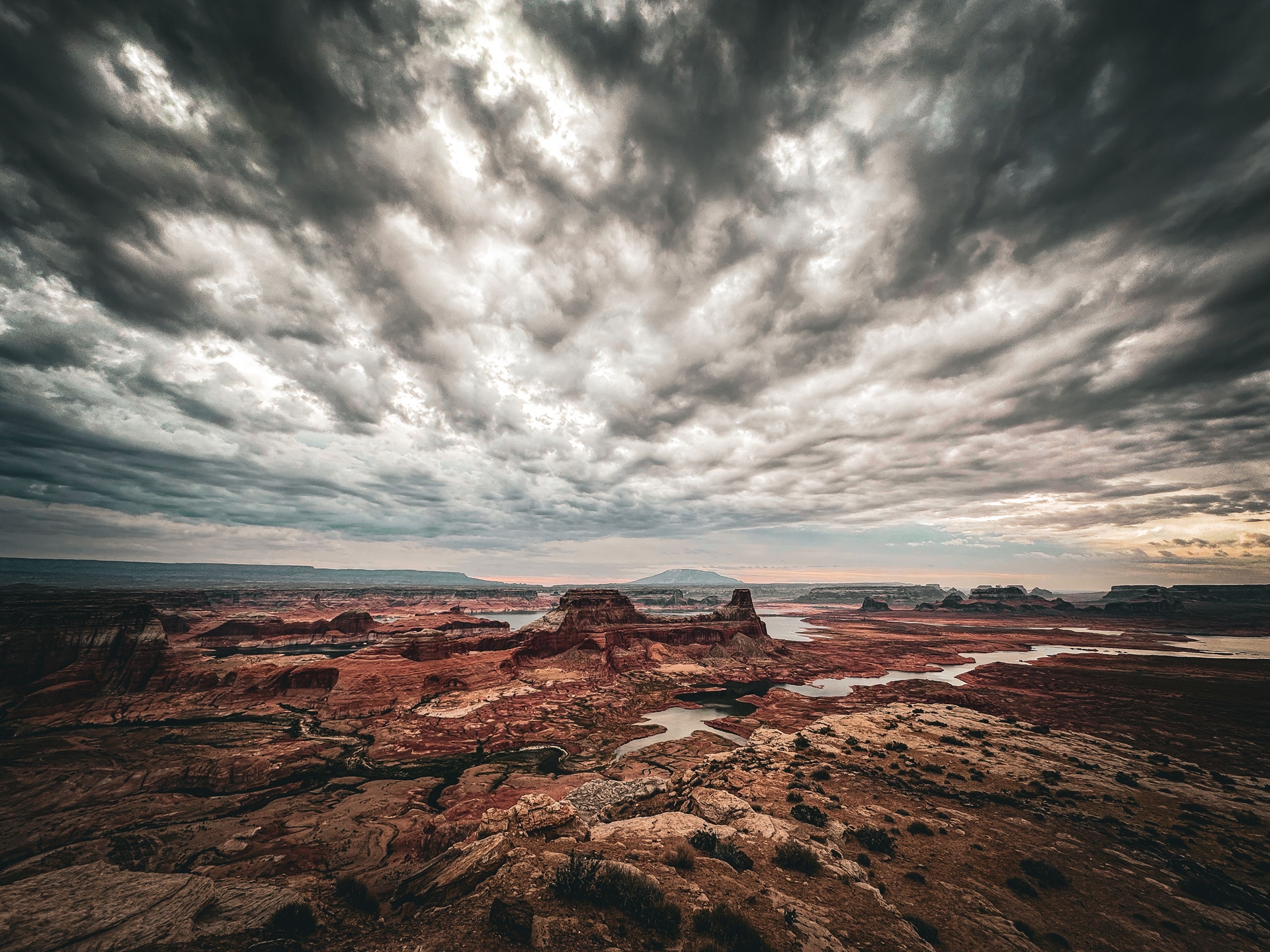
- Lake Powell is projected to fall below 3,510 feet during water year 2027.
- Reclamation is modeling Lake Powell releases of 6 million to 7 million acre-feet for 2027.
- Lake Powell inflow for water year 2026 is forecast at only 37 percent of average.
- Lake Mead will remain under a shortage condition in 2027.
- Reclamation says reservoir projections remain subject to uncertainty.
Saturday, August 22, 2026 — The Colorado River is heading into another difficult operating year, and the latest federal projections show why.
The Bureau of Reclamation released its August 2026 24-Month Studies on August 21. The studies examine possible conditions at Lake Powell, Lake Mead and other reservoirs across the Colorado River system.
One finding stands out.
Lake Powell is projected to fall below elevation 3,510 feet during water year 2027. As a result, the reservoir will be operated within what Reclamation calls the Low Elevation Infrastructure Protection Range.
That puts added importance on how much water will be released from Lake Powell through Glen Canyon Dam during the coming year.
Two Possible Release Volumes for Lake Powell.
Reclamation published two Most Probable 24-Month Studies for 2027.
One assumes a Lake Powell release of 6 million acre-feet. The other assumes a release of 7 million acre-feet.
That does not mean Reclamation has already settled on one of those amounts.
Under the 2027-2028 Operating Guidelines, the expected Lake Powell release for water year 2027 is within a range of 6 million to 7 million acre-feet. Reclamation also states that the eventual release could fall outside that range following appropriate consultation.
The final operational determinations for Lake Powell and Lake Mead will be documented in the 2027 Annual Operating Plan, which was still being developed when the August studies were released.
The August studies therefore provide projections of what could happen under the different operating choices rather than a single final answer for 2027.
Powell Is Already Operating Under Dry Conditions.
The new projections follow an exceptionally poor runoff year.
According to Reclamation, unregulated inflow into Lake Powell during July 2026 was only 83,000 acre-feet, or 9 percent of the 30-year average.
The August inflow forecast was 70,000 acre-feet, or 19 percent of average.
Preliminary unregulated inflow from April through July totaled 1.14 million acre-feet, just 18 percent of average. For the full 2026 water year, Lake Powell’s unregulated inflow was forecast at approximately 3.58 million acre-feet, or 37 percent of average.
Those dry conditions have already changed reservoir operations.
Lake Powell had originally been projected to release 7.48 million acre-feet during water year 2026. Reclamation reported that historically dry conditions persisted while reservoir projections showed Lake Powell declining below elevation 3,500 feet.
The Department of the Interior reduced the 2026 annual Lake Powell release from 7.48 million acre-feet to 6 million acre-feet.
More Water Is Being Released From Flaming Gorge.
The reduction at Lake Powell is being carried out along with another major reservoir operation upstream.
Under the 2026 Drought Response Operations Plan, approximately 660,000 acre-feet to 1 million acre-feet of additional water is expected to be released from Flaming Gorge Reservoir to Lake Powell by April 2027.
The August Most Probable 24-Month Studies use the upper end of that range and assume a 1 million acre-foot Drought Response Operations release.
Lake Powell Moves Into a New Operating Range.
The August projections also show how the reservoir’s elevation affects the rules governing its operation.
For water year 2027, Reclamation projects Lake Powell’s October 1, 2026 elevation will be below 3,540 feet. The reservoir is then projected to drop below 3,510 feet during water year 2027.
That places Lake Powell within the Low Elevation Infrastructure Protection Range established under the 2027-2028 Operating Guidelines.
The 6 million acre-foot Most Probable Study formally models a 6 million acre-foot release from Lake Powell during water year 2027.
A separate Most Probable Study models a 7 million acre-foot release.
The two studies allow Reclamation to examine reservoir conditions under both possibilities.
Lake Mead Remains Under Shortage.
Conditions at Lake Mead are also part of the operating picture.
A shortage condition governs Lake Mead operations during calendar year 2026 under the existing operating guidelines and Lower Basin Drought Contingency Plan.
Reclamation’s August study states that a shortage condition will also govern Lake Mead operations during calendar year 2027 under the new 2027-2028 Operating Guidelines. Lower Basin projections will also consider additional conservation efforts under those guidelines and the Lower Colorado River Basin Conservation and Efficiency Program.
For 2026, the Most Probable Study projects Colorado River diversions of 789,000 acre-feet for the Metropolitan Water District of Southern California and 963,000 acre-feet for the Central Arizona Project. Nevada’s consumptive use above Hoover Dam is projected at 201,000 acre-feet.
Reclamation also notes that changing Lake Mead elevations affect the generating capacity at Hoover Dam. The agency adjusts estimated generator capacity as projected reservoir elevations change and conducts unit capacity tests as lake levels change.
The Studies Show a Range, Not a Prediction Set in Stone.
The August release includes more than the two Most Probable studies.
Reclamation also prepared Probable Minimum and Probable Maximum scenarios to show a wider range of possible reservoir conditions.
The Probable Minimum scenario represents a dry hydrologic condition. The Most Probable scenario represents median conditions. The Probable Maximum scenario represents wetter conditions.
Reclamation says there is approximately an 80 percent probability that a future reservoir elevation will fall within the range between the Probable Minimum and Probable Maximum scenarios.
The agency also cautions that conditions could occur outside that range.
Even the wetter August scenario starts from a difficult 2026 water year. In the Probable Maximum study, Lake Powell’s unregulated inflow for water year 2026 is still listed at 3.59 million acre-feet, or 37 percent of average.
Under that scenario, Glen Canyon Dam releases 6 million acre-feet during water year 2026 and 7 million acre-feet during water year 2027. Lake Powell is projected at elevation 3,515.41 feet on September 30, 2026, while Lake Mead is projected at elevation 1,035.63 feet on December 31, 2026.
The Probable Minimum scenario uses a 6 million acre-foot Glen Canyon Dam release in both water year 2026 and water year 2027. Under that scenario, Lake Powell is projected at elevation 3,516.09 feet on September 30, 2026, and Lake Mead at elevation 1,034.19 feet on December 31, 2026.
Reclamation Will Continue Watching Conditions.
The Bureau of Reclamation emphasizes that its 24-Month Studies are modeling tools.
The studies begin with actual end-of-month reservoir elevations and then use different hydrologic scenarios to examine what may happen next. The Most Probable study uses middle-range forecasts during the first year and historical flows during the second year. The Probable Minimum and Probable Maximum studies model drier and wetter possibilities.
Water demand is also built into the projections. Upper Basin demands are incorporated into the inflow forecasts, while Lower Basin demands are developed in coordination with the Lower Basin states and Mexico.
Reclamation says all of the modeling assumptions and projections involve varying degrees of uncertainty.
The agency also says it will continue monitoring hydrologic and operating conditions while consulting with the Colorado River Basin states, Basin Tribes, Mexico and other partners about reservoir operations and possible additional measures.
For now, the August studies establish the range federal water managers are preparing to work within: another shortage year at Lake Mead, low-elevation operations at Lake Powell and a Lake Powell release during water year 2027 that is currently expected to fall somewhere between 6 million and 7 million acre-feet.



 wpDiscuz