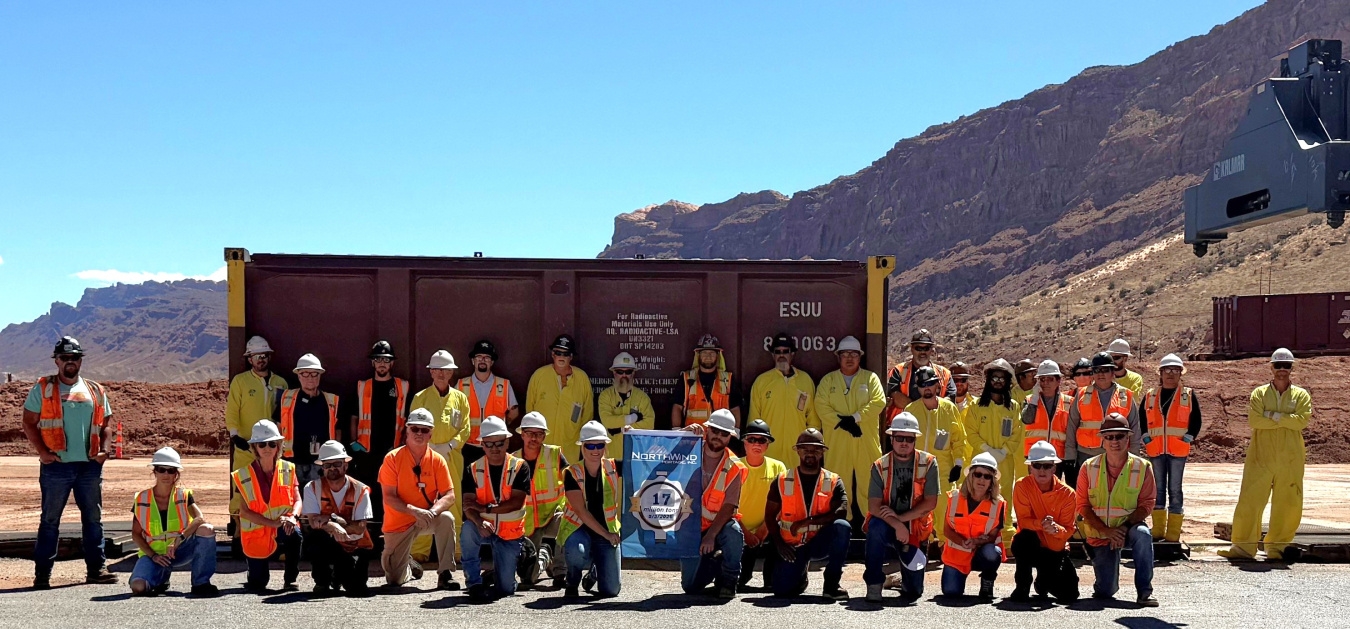
- Crews have removed 17 million tons of uranium mill tailings from beside the Colorado River.
- The radioactive waste has been shipped by rail to a disposal site about 30 miles away.
- Contaminated soil and groundwater still remain at the Moab site.
- Federal officials are developing a final plan to address the groundwater contamination.
- Surface cleanup work could continue through 2028.
Wednesday, September 30, 2026 — A decades-long cleanup beside the Colorado River near Moab, Utah, has reached a major milestone.
The U.S. Department of Energy announced September 29 that crews have removed 17 million tons of uranium mill tailings from the Moab site.
Mill tailings are the sandy, radioactive leftovers produced when uranium is processed from ore. For years, millions of tons of the material sat in an unlined area in the Colorado River floodplain, about three miles northwest of Moab.
Since April 2009, crews have been loading the tailings into containers and transporting them by rail to an engineered disposal cell near Crescent Junction, about 30 miles away.
Removing 17 million tons marks a major step in the cleanup, but it does not mean the work is finished.
Contamination Remains Underground.
The old tailings pile also created problems below the surface.
Liquids from the pile seeped into groundwater, carrying contaminants that included ammonia, uranium, manganese, copper, sulfate, selenium and arsenic.
Contaminated soil also remains beneath and around the former surface tailings pile. That soil can continue releasing ammonia and uranium into groundwater, which generally moves toward the Colorado River.
Conditions beneath the site are complicated.
Groundwater is about 15 feet below the surface. A layer of salty brine water lies deeper, at roughly 55 feet. Contaminants have reached both layers.
Water movement can also change with the seasons. Under normal conditions, groundwater flows toward the Colorado River. During spring snowmelt runoff, river water can push back into the aquifer and temporarily reverse that flow.
Protecting the River.
The Department of Energy has operated an interim system since 2003 to reduce contamination reaching sensitive habitat along the Colorado River.
Eight extraction wells pump contaminated groundwater from beneath the site. Ten injection wells put filtered river water underground, helping create a barrier between the contamination and the river. A surface-water system also supplies fresh water to sensitive riverbank areas when young endangered fish are present.
The system was designed as a temporary measure while the larger cleanup moved forward.
The Department of Energy must now determine how it will manage groundwater over the long term.
The Next Phase of the Cleanup.
The September 29 announcement lists several remaining jobs.
Crews still must remove contaminated soil beneath and next to the former surface tailings pile. The project must meet federal radiological standards and dispose of remaining equipment and infrastructure.
Workers also must finish the cover over the Crescent Junction disposal cell. The cover is intended to control moisture and protect the disposal site over the long term.
The Moab property eventually will be regraded and revegetated.
At the same time, federal officials are developing a final Groundwater Compliance Action Plan to address contamination beneath the site.
That work is especially complicated because scientists have concluded that there is no single, simple solution for the groundwater problem.
Experts from six national laboratories have examined possible approaches, including pumping and treating groundwater, allowing natural flushing to occur over time and using underground barriers to immobilize contaminants.
No final method had been selected as of the earlier Western-Water.com report. Scientists recommended additional field work and computer modeling to better understand how groundwater and contaminants move beneath the property.
A draft Groundwater Compliance Action Plan is scheduled for submission to the Nuclear Regulatory Commission in 2027.
From Moving Waste to Managing What Remains.
Surface cleanup could be completed as early as 2028.
When that work is finished, responsibility for the site is expected to shift within the Department of Energy from the Office of Environmental Management to the Office of Legacy Management.
The September 29 milestone shows how much of the visible problem has already been removed: 17 million tons of uranium mill tailings that once sat beside the Colorado River have now been hauled away.
The remaining work is increasingly focused on what cannot be loaded onto a train: contaminated soil and groundwater beneath the site, along with the long-term job of stabilizing and monitoring the property.
Image via the U.S. Department of Energy.