- Recent rain and mountain snow eased drought conditions across portions of the Colorado River Basin.
- California and Nevada saw no changes in their drought classifications during the latest reporting period.
- Severe flooding across the Four Corners region forced evacuations, rescues and road closures.
- Lake Powell remained at approximately 22% of capacity on October 20.
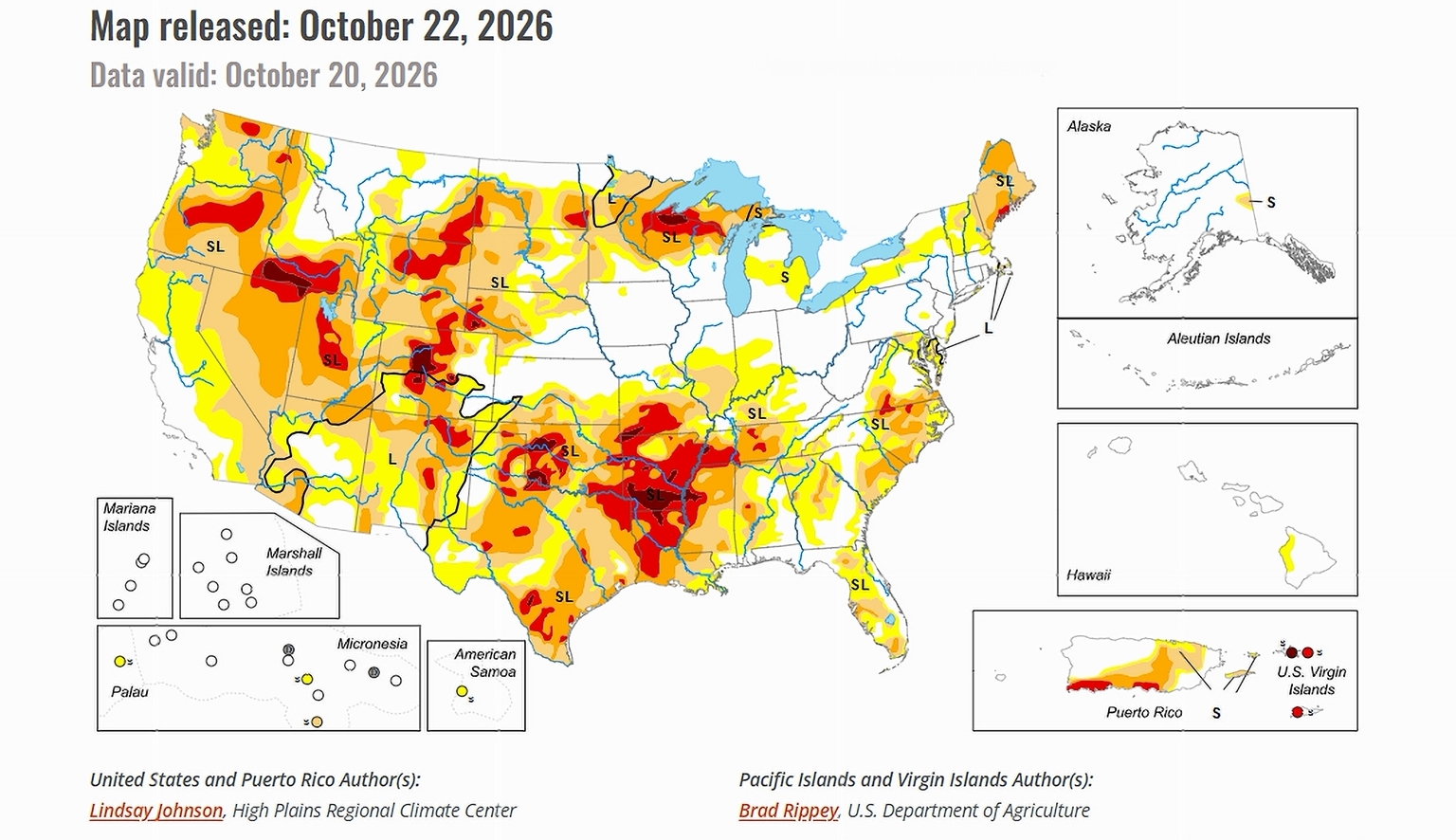
Saturday, October 24, 2026 — Drought conditions improved across large portions of the United States during the week covered by the October 22, 2026, U.S. Drought Monitor report . Heavy rainfall brought relief to parts of the southern Plains, while other regions continued to struggle with worsening dryness.
One of the biggest changes occurred in Texas and Oklahoma, where a powerful storm system delivered several inches of rain between October 13 and 15. Some locations in western and central Oklahoma received 6 to 8 inches. The rainfall helped replenish soil moisture and improve streamflows, although it also caused localized flooding.
Conditions were less favorable across the Lower Mississippi Valley and portions of the Ohio River Valley. Drought intensified in Arkansas, Louisiana, Mississippi, Tennessee and southern Missouri, where prolonged rainfall shortages continued to dry out soils and reduce streamflows.
Across the West, the picture was different. Recent storms brought welcome moisture to several drought-stricken areas, including portions of the seven Colorado River Basin states.
But the same general period of wet weather also brought dangerous flooding to the Four Corners region, where communities faced rising rivers, washed-out roads and emergency evacuations.
Rain and Mountain Snow Bring Relief to the Colorado River Basin.
The October 22 Drought Monitor reported improvements across portions of Arizona, Colorado, New Mexico, Utah and Wyoming.
A storm system moving through the Rocky Mountains on October 14 and 15 brought rainfall to lower elevations and snow to higher terrain. Some locations received more than twice their normal precipitation for the reporting period, with isolated areas receiving more than four times the normal amount.
Snowfall measurements included 4.3 inches at Silver Lake, Brighton, Utah, and 3 inches near Evanston, Wyoming, on October 14.
The moisture helped reduce short-term drought conditions in several areas.
In Colorado and Wyoming, rain and mountain snow improved conditions across portions of the Rocky Mountains. Utah experienced improvements along parts of the Wasatch Front, central mountains and southeastern Utah.
Arizona saw improvements across portions of its central mountains and eastern areas. In New Mexico, repeated rainfall over recent weeks helped ease dryness across central and southern portions of the state.
Eastern Colorado and eastern Wyoming also recorded localized improvements, although a small area of northeastern Colorado experienced worsening drought.
California and Nevada, meanwhile, saw no changes in their drought classifications during the reporting period. Both states received limited precipitation, with many western locations reporting less than 25% of their normal rainfall.
The Drought Monitor reported no deterioration in its western region, which includes the western portions of the Colorado River Basin states.
Lake Powell Remains Low Despite Recent Rain.
Although the recent storms improved short-term conditions, the Drought Monitor emphasized that long-term water shortages remain a concern.
On October 20, Lake Powell held approximately 5.3 million acre-feet of water, representing about 22% of its capacity, according to Bureau of Reclamation figures cited in the report.
An acre-foot is the amount of water needed to cover one acre of land to a depth of one foot.
The report noted that long-term hydrologic drought continued across portions of the Colorado River Basin despite the recent precipitation.
Hydrologic drought refers to shortages in rivers, reservoirs and other water supplies. These conditions can persist even after rainfall improves soil moisture and reduces short-term drought classifications.
The distinction matters in the Colorado River Basin, where the latest Drought Monitor showed improvements in several areas while Lake Powell remained at a low storage level.
Severe Flooding Strikes the Four Corners Region.
While the October 22 Drought Monitor documented improving conditions across portions of the Southwest, additional storms brought destructive flooding to the Four Corners region later in the week.
By October 23, rising rivers and overflowing washes had forced evacuations across portions of Colorado, New Mexico, Arizona and Utah. Emergency crews used boats and specialized vehicles to reach residents trapped by floodwaters.
In Farmington, New Mexico, officials ordered approximately 600 households to evacuate as the San Juan and Animas rivers rose. Floodwaters entered homes and businesses, and emergency responders conducted rooftop rescues.
Southern Colorado also experienced extensive flooding. Governor Jared Polis declared a disaster emergency covering 11 counties. Rising water along the San Juan River prompted evacuations near Pagosa Springs, while flooding around South Fork submerged vehicles and surrounded trailers at a campground.
In southwestern Utah, the city of Hurricane declared a local emergency on October 22 after floodwaters swept through residential neighborhoods. Approximately 80 homes and 50 recreational vehicles were affected.
On the Navajo Nation, flooding damaged roads and threatened homes in Dennehotso, Arizona. Emergency responders rescued seven families, totaling 30 people, from flooded homes on October 23.
Repeated Storms Leave the Ground Saturated.
The flooding followed several rounds of heavy precipitation across the Southwest.
According to reporting from the Four Corners region, National Weather Service meteorologists said repeated storms had left the ground saturated. Additional rainfall increased runoff into washes, streams and rivers.
The region’s rocky terrain and limited vegetation also contribute to flash-flood hazards.
The combination of saturated ground and additional rainfall created dangerous conditions even in communities accustomed to dry weather.
In New Mexico, the flooding also affected infrastructure. Rising water along the San Juan and Animas rivers prompted the temporary shutdown of a water reclamation facility in Bloomfield.
More Rain Forecast for the Colorado River Basin.
The October 22 Drought Monitor also included precipitation and temperature outlooks extending through the end of October.
For October 22–27, forecasters expected widespread precipitation across portions of the central and southern Rocky Mountains, particularly Colorado and northern New Mexico.
Rainfall totals of 1 to 3 inches were forecast across broad areas, with isolated locations potentially receiving 5 inches or more.
Additional precipitation was expected across portions of Arizona, Utah and New Mexico, while southern California and the lower desert regions were expected to remain comparatively dry.
Looking farther ahead, the Climate Prediction Center’s October 26–30 outlook favored above-normal precipitation across a broad region extending from California into the Southwest, including portions of Arizona and New Mexico.
Above-normal temperatures were also favored across much of the southern United States, including California and the Southwest.
The outlook noted that continued warmth could increase evaporation and reinforce existing moisture shortages in areas that receive little rainfall.
The forecast represents expected conditions, not rainfall already measured. The October 22 Drought Monitor classifications also precede some of the severe flooding reported on October 23.
Sources:
-
U.S. Drought Monitor — October 22, 2026 report. National drought conditions, western regional improvements, Lake Powell storage and precipitation outlooks.
-
Boise State Public Radio / Mountain West News Bureau — October 23, 2026. Four Corners flooding, evacuations, Navajo Nation rescues and emergency declarations.
-
The Guardian — October 23, 2026. Flooding across the Four Corners region, emergency response and storm conditions.
-
Sentinel Colorado — Four Corners flooding. Colorado and Utah flooding, evacuations and storm damage.
-
The Daily Advance — Severe Four Corners flooding. Rooftop rescues and evacuation orders.
-
WSB-TV — Four Corners flooding. Regional flooding and emergency response.