- A chemical from vehicle tires is entering California creeks and rivers during rainstorms.
- Researchers detected the pollutant in 98% of water samples.
- Nearly 70% of storm samples exceeded a concentration considered potentially deadly to young coho salmon.
- Creeks near heavily traveled roads had some of the highest pollution levels.
- Scientists warn that restoring fish habitats without improving water quality could put endangered fish at greater risk.
Monday, October 26, 2026 — A chemical that helps protect vehicle tires from damage is finding its way into California waterways, sometimes at levels that could kill endangered fish.
A study publicized by the American Chemical Society on October 22, 2026 , found potentially dangerous concentrations of a tire-related pollutant in creeks and rivers along California’s central coast.
The chemical, known as 6PPD-quinone, was detected in nearly every water sample collected during a November 2025 rainstorm. Many of those samples came from waterways designated as critical habitat for endangered coho salmon and threatened steelhead trout.
The findings, published in the scientific journal Environmental Science & Technology Letters, raise concerns about the quality of water flowing through habitats where these fish live and reproduce.
How Tire Chemicals Reach Rivers.
Vehicle tires contain a chemical called 6PPD that helps protect rubber from damage caused by ozone in the air.
When that chemical reacts with ozone, it forms another substance called 6PPD-quinone.
As tires wear down, tiny particles containing tire-related chemicals accumulate on roads. Rain washes these pollutants into storm drains, creeks and rivers.
The resulting pollution can be particularly dangerous to certain fish, including coho salmon and steelhead trout.
Researchers have already established that 6PPD-quinone can be highly toxic to these species. However, less was known about how much of the chemical was reaching protected fish habitats along California’s central coast.
What Researchers Found.
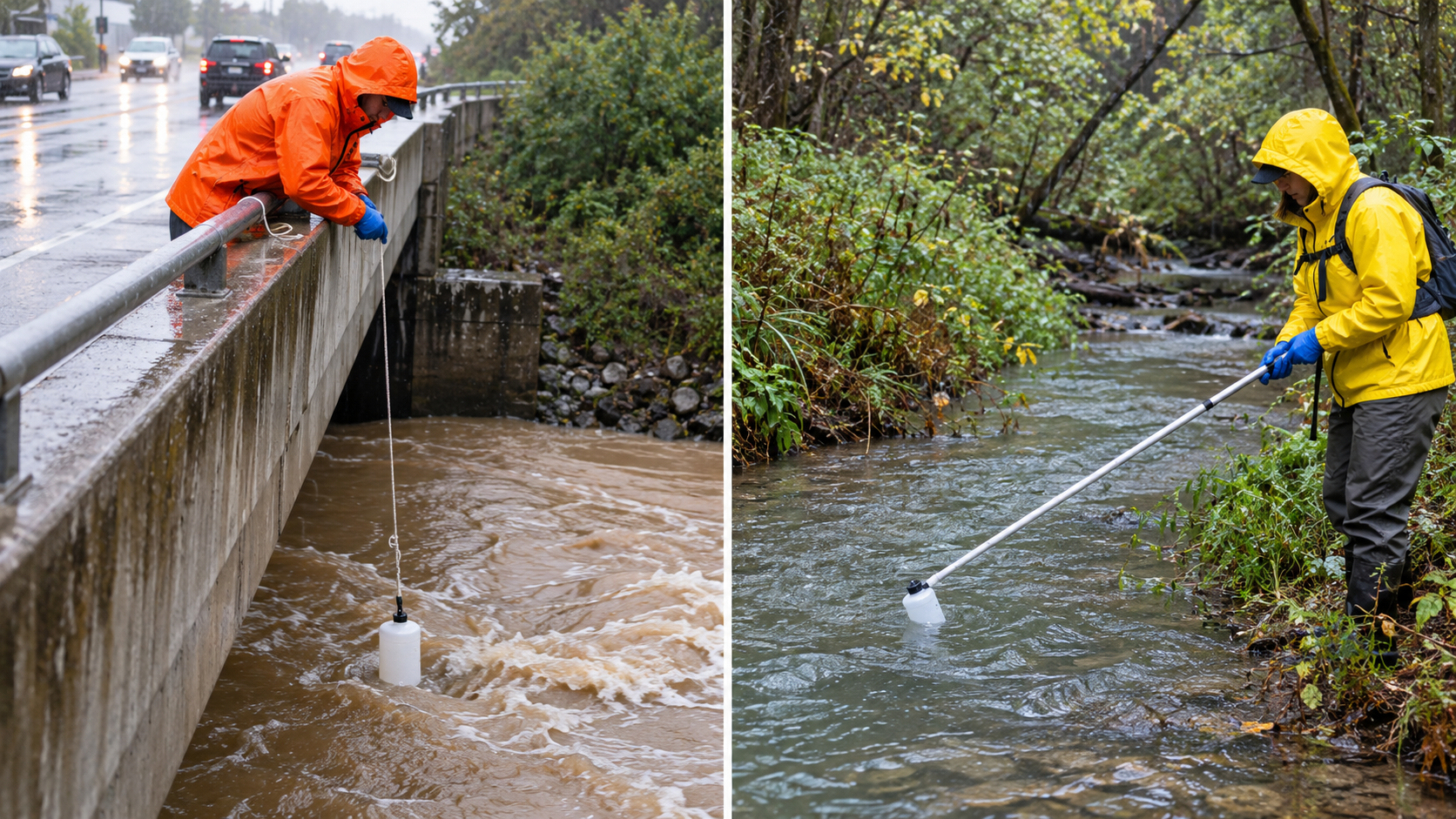
On November 13, 2025, scientists collected water samples during a powerful rainstorm in the San Francisco Bay region and nearby coastal watersheds.
The investigation included six roadway drainage outlets, 14 creeks and rivers, and two coastal estuaries, where freshwater meets ocean water.
Researchers collected 59 samples during the storm, along with additional samples taken before rainfall began.
The results showed widespread contamination.
The chemical was detected in 98% of all 65 samples collected.
Among the 59 storm samples:
-
78% exceeded the Environmental Protection Agency’s screening level for potential short-term harm to aquatic life.
-
69% exceeded a concentration known to kill half of juvenile coho salmon exposed under laboratory conditions for 24 hours.
The second finding does not mean that 69% of the fish died. It means the measured pollution levels exceeded a concentration associated with serious harm in laboratory testing.
The study measured chemical concentrations in water, not actual fish deaths during the storm.
Busy Roads Had the Highest Pollution.
Contamination varied considerably between locations.
Roadway drainage outlets generally contained the highest concentrations. Creeks near heavily traveled roads also showed elevated levels.
In contrast, samples collected from coastal estuaries had much lower concentrations.
The researchers found a significant relationship between traffic volume and the amount of 6PPD-quinone entering nearby waterways.
Some of the highest readings occurred in Branciforte Creek and Soquel Creek near Santa Cruz.
Branciforte Creek reached 230 nanograms per liter, while Soquel Creek reached 180 nanograms per liter.
A nanogram is one-billionth of a gram. Although these amounts are extremely small, the chemical can be dangerous to sensitive fish at very low concentrations.
For comparison, the researchers used 41 nanograms per liter as a benchmark for potentially lethal exposure to juvenile coho salmon.
The highest concentration measured anywhere in the study was 1,100 nanograms per liter at a roadway drainage outlet near Aptos Creek.
Pollution Can Last for Hours.
The study also examined how chemical concentrations changed as the storm continued.
At most locations, pollution levels were highest early in the rainfall, when runoff began washing accumulated material from road surfaces.
However, dangerous concentrations did not always disappear quickly.
At several locations, pollution remained near or above potentially lethal levels for four to six hours.
Even the San Lorenzo River, which carried substantial amounts of water during the storm, had elevated readings.
The findings indicate that heavy river flows do not necessarily eliminate short-term exposure risks.
Researchers also cautioned that their samples represented conditions at specific locations and times. The measurements did not establish pollution levels throughout entire rivers.
Because the investigation focused on a single storm, additional research is needed to understand how concentrations change during different weather conditions and seasons.
A Restored Creek With Toxic Water.
One of the study’s most troubling findings involved Branciforte Creek.
The creek had undergone an approximately $394,000 restoration project intended to improve habitat for salmon and trout.
Yet researchers recorded one of the highest pollutant concentrations in the entire study at that location.
The finding highlights a problem that can arise when efforts to improve fish habitat focus on physical conditions without also addressing water pollution.
Removing barriers and improving spawning areas can make a creek more attractive to fish. But if the water contains dangerous chemicals, those improvements may not provide the expected protection.
Researchers describe this situation as an ecological trap, in which animals are drawn into habitat that appears suitable but exposes them to danger.
“A great habitat with toxic water quality makes the problem worse. You are creating an ecological trap for the fish,” said Ed Kolodziej, the study’s corresponding author.
The researchers recommended that habitat restoration and water quality improvements be considered together, particularly in waterways supporting endangered and threatened species.
What Can Be Done About Tire Pollution?
The study identifies two potential approaches to reducing contamination.
One involves treating stormwater runoff from heavily traveled roads before it reaches nearby waterways.
The other involves developing tire materials that are less toxic or non-toxic when released into the environment.
Both approaches would address different parts of the problem.
Stormwater treatment could reduce the amount of pollution reaching streams, while changes in tire materials could reduce the source of the harmful chemical.
However, researchers emphasized that 6PPD-quinone is not the only pollutant carried by roadway runoff.
“6PPD-quinone is not the only harmful component of roadway runoff, so finding scalable and cost-effective solutions is important,” Kolodziej said.
The researchers also called for additional studies examining the effects of the chemical on fish populations and how best to manage contamination in protected watersheds.
The research was supported by Earthjustice and the Allan and Inger Osberg Endowed Professorship. A National Oceanic and Atmospheric Administration grant helped support the purchase of laboratory instruments.
Sources:
1. American Chemical Society. “Tire-derived pollutant found at elevated levels in critical fish habitats.” Science Release, October 22, 2026.
2. Maxwell, Kiersten; Martin, Kaylee; Wang, Wei; Everton, Emily; Gonzalez, Melissa; and Kolodziej, Edward P. “Potentially Lethal Concentrations of 6PPD-Quinone Occur in Endangered Species Act Listed Aquatic Habitats of Central California.” Environmental Science & Technology Letters, Volume 13, pages 1403–1410. Published September 26, 2026. DOI: 10.1021/acs.estlett.6c00745.
Image: Researchers collected water samples from the Waddell estuary (left) and Carbonera Creek (right) to determine how much of a tire-derived pollutant could wash into Central California waterways during storms. Adapted from Environmental Science & Technology Letters 2026, DOI: 10.1021/acs.estlett.6c00745