
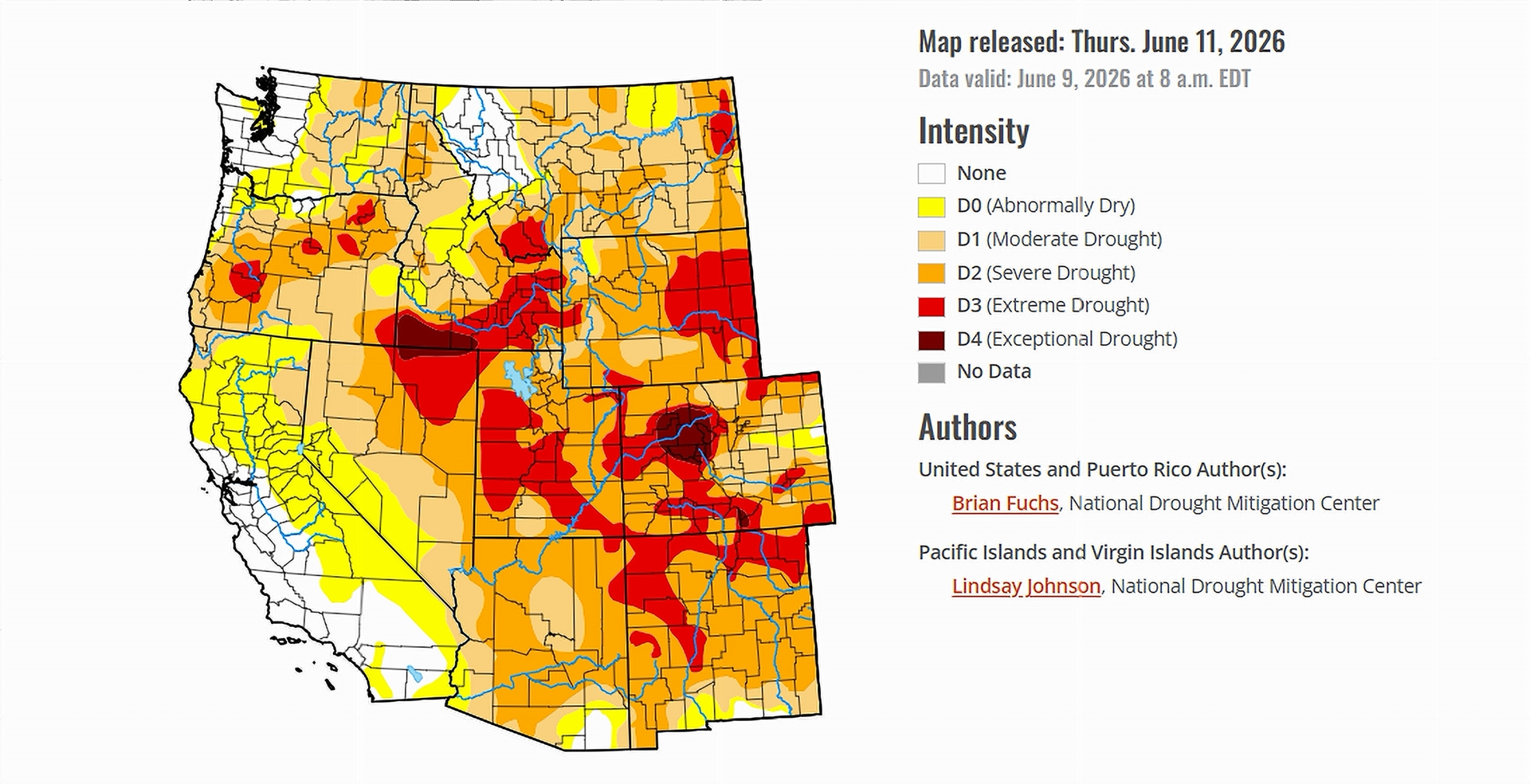
- A harsh winter legacy lingers. A season marked by above-normal temperatures and below-normal snowpack continues to shape drought conditions across the Colorado River Basin heading into summer.
- Colorado sees mixed signals. Extreme drought expanded in eastern and northern Colorado, while southern Colorado received some relief from recent rainfall.
- New Mexico stands out as a bright spot. Southern and eastern portions of the state recorded precipitation totals exceeding 200 percent of normal, driving notable improvements.
- The West faces a dry and hot stretch ahead. Forecasters expect the region to remain largely dry over the next 5–10 days, with temperatures in Nevada forecast to run more than 10 degrees above normal.
Saturday, June 13, 2026 — Across the United States, the week ending June 11, 2026, brought a patchwork of weather — heavy summer thunderstorms in some corners of the country, persistent dryness in others. The greatest rainfall departures from normal fell across parts of the central and southern Plains, West Texas, and the Midwest, while the East Coast stayed mostly dry. Florida’s Atlantic coast was a notable exception.
For much of the American West, however, the story was familiar: little rain, rising temperatures, and a drought that refuses to let go.
The West: Dry by Default.
The U.S. Drought Monitor’s latest report, released June 11, paints a sobering picture for the western United States. Aside from scattered rainfall along the Pacific Northwest coast and parts of southern California, most of the West recorded below-normal precipitation for the week.
Temperature departures told an even starker story. Across Nevada, Utah, and western Colorado, thermometers ran 6 to 9 degrees above normal — a heat load that accelerates evaporation, stresses vegetation, and deepens soil moisture deficits that are already running well below average.
Underpinning all of it is a difficult inheritance from the most recent winter season. The Drought Monitor’s authors note plainly that “a winter characterized by above-normal temperatures and below-normal snowpack continues to affect the region and will likely influence conditions through the summer.” For a region that depends heavily on mountain snowpack to fill its rivers and reservoirs, that sentence carries serious weight.
Colorado: Drought Expands in the East, Eases Slightly in the South.
Within the Colorado River Basin, the state of Colorado itself saw conditions move in two directions at once. In eastern Colorado, extreme drought (the second-most severe category on the Drought Monitor’s five-level scale) expanded across the northern part of the state, while moderate drought (the mildest drought designation) spread across east-central portions.
Southern Colorado received a reprieve of sorts. Recent rainfall allowed extreme drought to contract slightly in that area — a modest but welcome development in a state dealing with widespread dryness.
New Mexico: A Week of Welcome Rain.
Not all the news from the Basin was grim. In southern and eastern New Mexico — portions of the state that drain into or influence the broader Colorado River system — precipitation totals for the week exceeded 200 percent of normal. That exceptional rainfall drove additional drought improvements across those areas, offering some relief in a state that has spent much of the past several years under drought stress.
Temperatures in eastern New Mexico also ran cooler than normal, averaging 3 to 4 degrees below average — a contrast to the heat baking states to the west.
Nevada and Utah: Heat Takes Center Stage.
Nevada and Utah offer little good news in this week’s report. Both states saw temperatures running well above normal, and neither received meaningful precipitation during the reporting period. Nevada, in particular, is flagged repeatedly in the outlook section as a focal point for exceptional heat in the days ahead.
While the Drought Monitor did note that extreme drought improved across much of eastern Utah following recent precipitation, the broader picture for both states remains one of persistent dryness reinforced by above-normal heat.
California and Wyoming: Limited Data, Ongoing Concern.
The report notes that portions of southern California recorded near- to above-normal precipitation for the week — a relatively positive signal for the southern end of the Basin. However, the outlook for the coming 6 to 10 days shows above-normal chances of below-normal precipitation for northern California, which would work against any recent gains.
Wyoming was not specifically addressed in the report’s regional summaries.
What’s Coming: More Heat, Less Rain.
The near-term forecast offers little comfort for the Colorado River Basin. Over the next 5 to 7 days, the West is expected to remain “quite dry,” according to the Drought Monitor. The northern portions of the Southwest are forecast to receive less than one inch of precipitation — not enough to meaningfully dent drought conditions.
Temperature outlooks are equally striking. Departures of more than 10 degrees above normal are forecast for Nevada and parts of the Pacific Northwest. Looking further out, the 6- to 10-day outlook shows the greatest chances of above-normal temperatures centered on Nevada — with much of the surrounding Basin expected to follow suit.
Above-normal chances for below-normal precipitation are forecast for northern California, Nevada, and into Oregon — meaning the dry trend across the heart of the Basin is expected to continue.
The Bottom Line.
The Colorado River Basin enters the summer of 2026 carrying the weight of a difficult winter and a dry, hot spring. While isolated pockets — particularly in parts of New Mexico and southern Utah — have seen recent rainfall bring some relief, the broader region remains stressed. With heat building and rain staying away, the Drought Monitor’s next several weekly reports will be watched closely by water managers, farmers, tribal communities, and the tens of millions of people who depend on the Colorado River system for their water supply.
Data and drought designations are sourced from the U.S. Drought Monitor report released June 11, 2026, produced by the National Drought Mitigation Center at the University of Nebraska-Lincoln in partnership with the U.S. Department of Agriculture and the National Oceanic and Atmospheric Administration. The full report and interactive maps are available at droughtmonitor.unl.edu .
.


 wpDiscuz