- State water managers started a $2.37 million gravel project last week to restore spawning habitat for Chinook salmon and steelhead trout in the Feather River.
- A separate $8 million upgrade to a popular Oroville boat ramp and campground is underway, temporarily closing the area to the public.
- Lake Oroville stood at 81 percent of its total capacity as of July 16, 2026, which is 111 percent of the historical average for this time of year.
Monday, July 20, 2026 — Salmon need just the right kind of gravel to have babies. Not too big, not too small. Rounded river rock, roughly one to four inches across, is the sweet spot. Female salmon, called hens, use their tails to dig nest-like hollows in that gravel called “redds,” where they lay their eggs. Too much fine sediment smothers the eggs. Too-large rocks are too heavy to move.
The problem at the Feather River is straightforward: Oroville Dam sits upstream, and it blocks the natural flow of gravel downstream. Without regular gravel deposits, good spawning habitat slowly disappears.
To fix that, the California Department of Water Resources announced on July 17, 2026, that it is launching a new gravel supplementation project along the Feather River between the Table Mountain Bridge and Bedrock Park in Oroville. The work will place approximately 7,900 cubic yards of spawning gravel into the river, enough to fill roughly 580 standard dump trucks.
Crews began mobilizing heavy equipment and supplies the week of July 20, with actual in-water construction scheduled to begin the week of July 27. The project is expected to wrap up by the end of August.
“Because gravel doesn’t naturally flow downstream of Oroville Dam, gravel supplementation is necessary to provide sufficient spawning habitat to support existing salmonid populations,” the Department of Water Resources stated in its July 17 update.
The $2.37 million project is funded largely through a state habitat restoration grant tied to California’s Assembly Bill 179, passed in 2022. Reclamation District 1500 in the Sutter Basin is handling the construction.
This is not the first time the state has taken this step. The Department of Water Resources placed 8,300 cubic yards of spawning gravel in the Feather River in 2014, another 5,000 cubic yards in 2017, and 8,000 cubic yards in 2023.
Watch Out on the Water.
River users should expect some unusual traffic during construction. Flaggers will be stationed in the water itself to direct boats and floaters safely through the work zones. Anyone planning to kayak, raft, or fish along that stretch of the Feather River should stay alert and follow the directions of construction crews.
The work zone runs between the Table Mountain Bridge and Bedrock Park, a popular recreation corridor in the Oroville area.
A Popular Boat Ramp Gets a Major Upgrade.
Salmon season is open on the Feather River, but one well-known launch spot will be off-limits for a while. The Thermalito Afterbay Outlet, a favorite put-in for boaters and shoreline anglers, is closed to the public while a major reconstruction project gets underway.
The Sutter Butte Flood Control Agency is managing the $8 million project in collaboration with the Department of Water Resources and the California Department of Fish and Wildlife. When finished, the facility will feature a brand-new two-lane concrete boat ramp, an improved ramp for smaller non-trailered boats, a 25-unit primitive campground, a day-use picnic area, new recreational trails, and paved parking with room for 47 trailered vehicles and 31 single spaces. Contractor R&R Horn of Chico is doing the work, with completion expected in the spring or early summer of 2027.
In the meantime, nearby alternatives for trailered boat ramps include Riverbend Park, the Vance Avenue Boat Ramp, and Gridley. Boaters with car-top vessels can still launch at the Feather River Fish Hatchery, Bedrock Park, Vance Avenue Outlet, and the Pacific Heights Weir Ramp. People floating past the Afterbay Outlet area should use extra caution, as river flows in that area can shift without notice.
Salmon Are Coming Back.
State biologists resumed fish counting at the Feather River monitoring station on March 4, 2026, after a brief pause caused by high winter flows. The numbers, tracked through July 12, 2026, offer a window into how salmon and trout populations are doing.
Between March 4 and June 30, 2026, a total of 8,475 spring-run Chinook salmon were counted moving upstream. From July 1 through July 12, 622 fall-run Chinook salmon had also been recorded heading upriver.
The steelhead count showed a net figure of negative 15, meaning slightly more fish were moving downstream than upstream during that period. Biologists note those fish are most likely “kelts,” which are steelhead that have already spawned and are making their way back down to the ocean.
The Reservoir Is in Good Shape.
As of 11:59 p.m. on July 16, 2026, Lake Oroville sat at 856 feet in elevation, holding approximately 2.79 million acre-feet of water. That represents 81 percent of the reservoir’s total storage capacity and 111 percent of the historical average for mid-July. One acre-foot is roughly 325,000 gallons, enough to supply the needs of one to two households for an entire year, so 2.79 million acre-feet is a substantial amount.
Feather River flows through the City of Oroville were running at 850 cubic feet per second, with an additional 7,150 cubic feet per second being released from the Thermalito Afterbay River Outlet, for a combined total of 8,000 cubic feet per second heading downstream. The Department of Water Resources reviews and adjusts those release amounts on a daily basis.
Residents and outdoor enthusiasts who want to track reservoir levels, snowpack, and precipitation in real time can visit the California Data Exchange Center online. The Lake Oroville gage station is listed under the identifier “ORO.”
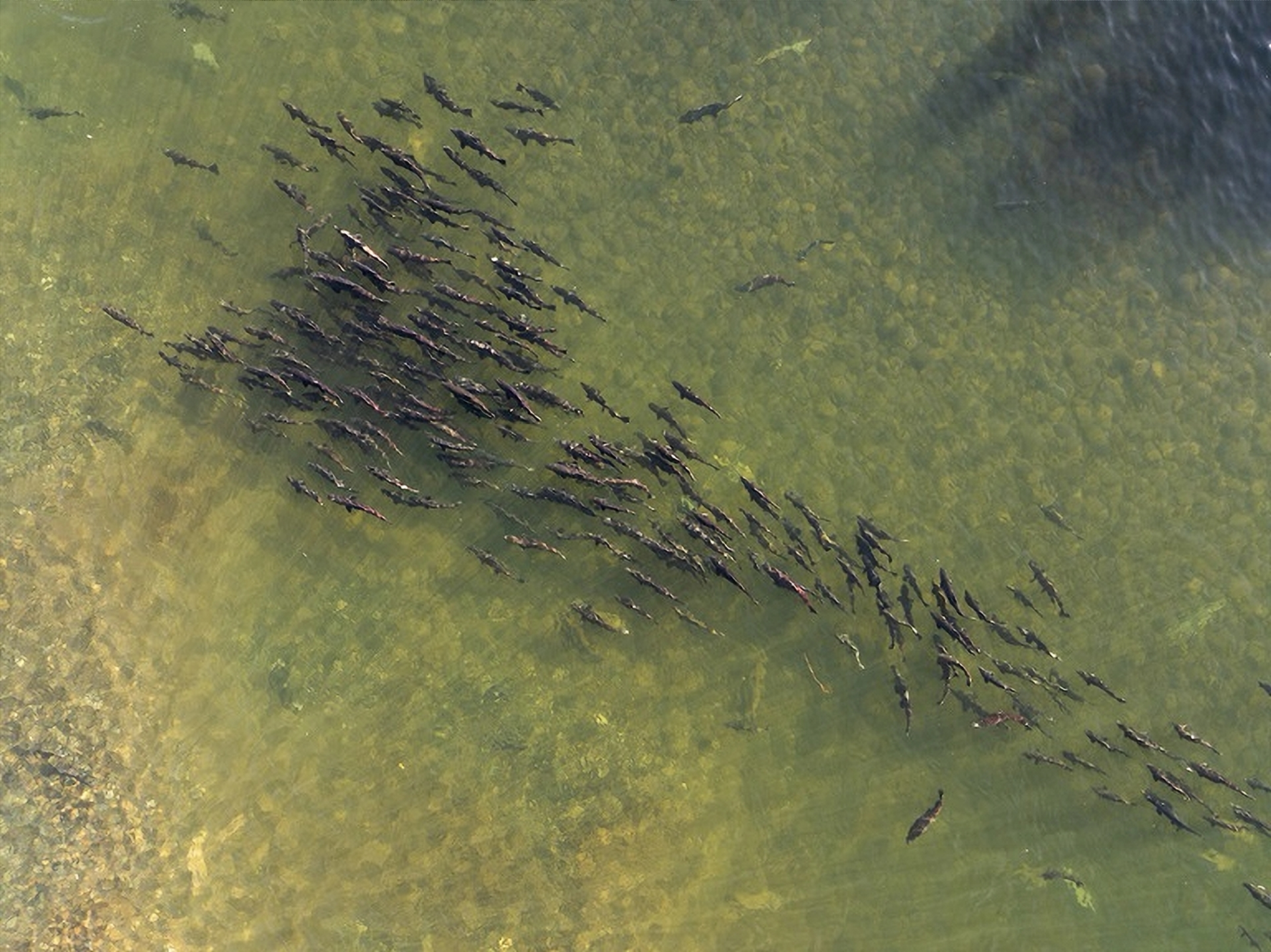
Pictured: A drone view of Fall-run Chinook salmon migrate and spawn in the Feather River near California Department of Water Resources infrastructure and the Feather River Fish Hatchery in Oroville, Butte County, from the California Department of Water Resources.