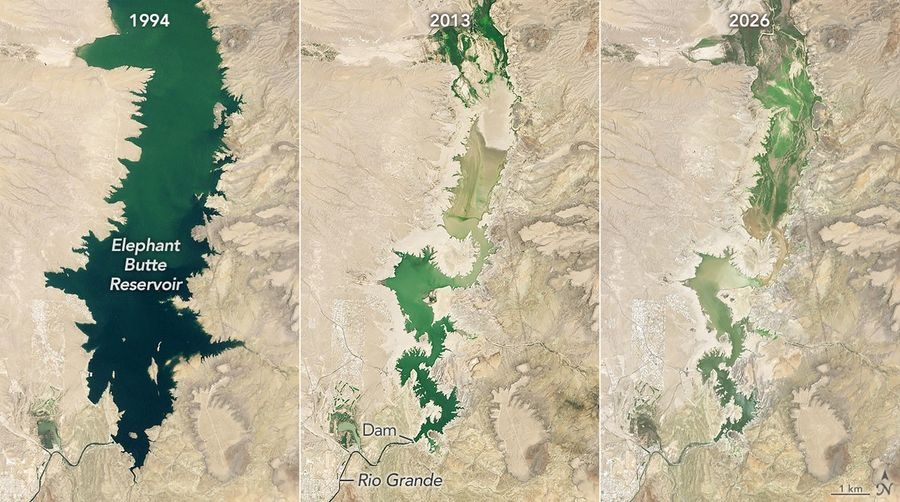
- New Mexico’s largest reservoir sat at just 1.4 percent full on August 20, 2026.
- The lake fell to its lowest point since 1971 during the summer.
- Record-early snowmelt in the southern Rockies deepened the shortfall.
- Irrigation releases stopped after July 28, letting the lake slowly refill.
- The reservoir feeds farm fields and part of El Paso’s water supply.
Friday, August 21, 2026 — NASA recounts that back in 1962, astronaut John Glenn looked down from orbit and noticed a green, watered valley northwest of El Paso, Texas, standing out against the brown desert around it. That green came from farms fed by human-made lakes along the Rio Grande. For generations, those lakes turned dry ground into cropland, supporting alfalfa, cotton, onions, pecans, and the area’s famous Hatch green chiles.
More than sixty years later, the water that made the valley bloom is running thin.
A Reservoir Near Empty.
Elephant Butte Reservoir, the largest reservoir in New Mexico, has fallen to its lowest level since 1971. When a NASA satellite captured the lake on July 27, 2026, it held only 1.4 percent of the water it can store. Nearly a month later, the reservoir remained at 1.4 percent full. Figures from the Texas Water Development Board show it holding about 27,369 acre-feet of water behind the dam on August 20, 2026.
The drop over a single year is sharp. On the same date in 2025, the lake was 3.8 percent full, with roughly 74,334 acre-feet in storage. The decline within 2026 stands out even more. In late spring the reservoir was far higher, at about 11.5 percent full on May 20, 2026. It fell steeply through the summer months.
What Pushed the Water So Low.
The Rio Grande basin has struggled through several years of harsh drought. Extreme dry conditions have gripped the region, and 2026 brought an added blow. Snow at the river’s headwaters in the southern Rockies melted earlier than in any year on record. Snowmelt normally feeds the river through spring and into early summer, so an early melt left less water moving downstream when farms needed it most.
The low water left visible marks. Receding water uncovered debris along the shoreline. At Elephant Butte Lake State Park, boat ramps ended up buried in sediment.
Why the Reservoir Matters.
Elephant Butte does far more than fill a state park. The lake is governed by the Rio Grande Compact, an agreement signed in 1938 by Colorado, New Mexico, and Texas and approved by the U.S. Congress to fairly divide the waters of the Rio Grande Basin. Water stored in the reservoir supplies irrigation for farms and, when available, part of El Paso’s water supply. Both New Mexico and Texas draw on the surface water and groundwater of the valley, which forces careful planning over how the supply is stored and shared.
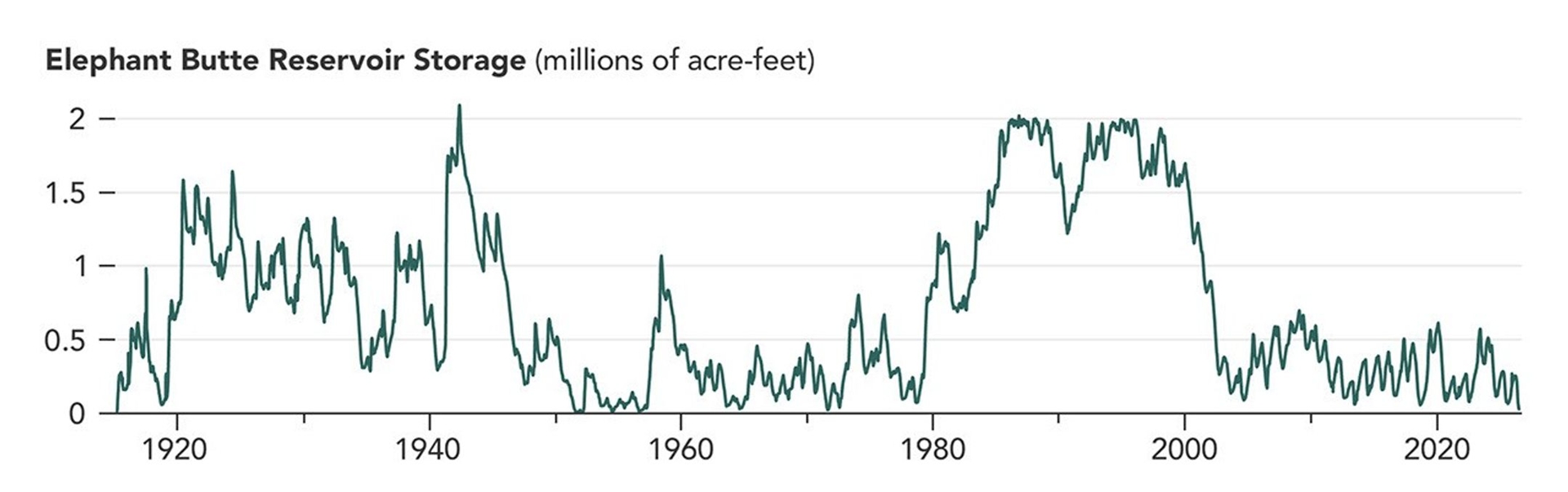 shows how the level of Elephant Butte Reservoir has varied from the lake’s creation in 1915 to summer 2026. NASA Earth Observatory/Michala Garrison
Slow Signs of Recovery.
There is a small measure of relief. State officials said water releases for agriculture stopped after July 28, 2026, which allowed the lake to slowly begin refilling. The reservoir likely reached its yearly bottom in late July. Daily readings in mid-August showed storage inching upward again, though the lake stayed far below normal.
Tools to Help Water Managers.
As the long drought sharpens the region’s water problems, researchers have looked for better ways to track and share what remains. Several projects backed by NASA’s Western Water Action Office are working to put satellite data and new tools in the hands of water managers.
One effort built a model that pulls in NASA satellite readings of soil moisture and of water lost from land and plants into the air. The result is a near-real-time tool that supports the Elephant Butte Irrigation District’s existing water allocation work. Another project combined satellite measurements of water surface heights with drone and ground data to show how groundwater pumping affects the flow of the Rio Grande. The office says that information can help managers administer water rights. NASA scientists are also part of a federal study of the Upper Rio Grande that seeks to understand water needs, forecast future supply, and build data-driven tools to meet those needs.
The valley has leaned on stored water since Elephant Butte began holding back the Rio Grande in 1915. For now, the lake sits near the bottom of its long record, gaining water slowly as another dry summer winds down.
Pictured at top: New Mexico’s Elephant Butte Reservoir was nearly full on June 2, 1994 (left), in contrast with very low levels during periods of drought on July 8, 2013 (center), and July 27, 2026 (right). The images were acquired with the TM (Thematic Mapper) on Landsat 5 and the OLI (Operational Land Imager) on Landsat 8 and Landsat 9. NASA Earth Observatory/Michala Garrison