- Arizona’s water bank is shifting from storing Colorado River water to using its stored water credits.
- The bank has accumulated more than 4.4 million acre-feet of long-term storage credits.
- Many Central Arizona Project urban water users are expected to face shortages beginning in 2027.
- Stored water credits can help provide backup supplies when Colorado River deliveries are reduced.
- Arizona also has water-banking responsibilities for Tribal supplies and Nevada.
Monday, October 5, 2026 — For decades, Arizona prepared for a day when there might not be enough Colorado River water to go around.
That day is changing the Arizona Water Banking Authority’s job.
Instead of concentrating on putting unused Colorado River water underground for the future, the Water Bank is increasingly focused on how to use the water credits it has already accumulated to help soften the effects of shortages.
“We used to bank water through the storage of Colorado River. We do not do that anymore,” Arizona Water Banking Authority Director Rebecca Bernat said in an Arizona Department of Water Resources article published October 1 .
.
From saving water to using the savings.
The Arizona Water Banking Authority was created in 1996 to store unused portions of Arizona’s annual Colorado River entitlement in Central and Southern Arizona.
The concept was fairly straightforward. When Colorado River water was available but not being used, it could be stored underground in aquifers. That storage earned what are called long-term storage credits.
Those credits have value during a shortage. Water can later be pumped from underground to provide backup supplies for certain water users.
The water industry calls that process “firming.”
Through 2024, the Water Bank had accumulated more than 4.4 million acre-feet of long-term storage credits. About 3.8 million acre-feet were for Arizona uses, while 613,846 acre-feet were stored for Nevada.
But the conditions that allowed Arizona to put excess Colorado River water underground have changed.
With less excess Central Arizona Project water available and continued Colorado River shortages increasingly likely, the Water Bank is moving into the next phase of its work.
That means drawing on the savings account rather than continuing to fill it.
Urban water users face changes in 2027.
On July 17, the Water Bank’s Commission approved extending its current approach for helping water users through shortages through 2027.
That year is expected to mark an important change because many urban water users served through the Central Arizona Project are expected to experience shortage impacts.
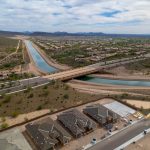
The Central Arizona Project carries Colorado River water into Central and Southern Arizona.
The Water Bank can use its accumulated credits to help municipal and industrial water users that hold Central Arizona Project contracts, along with certain Colorado River communities.
“Because of shortages on the river, we have started to distribute some of the water that we’ve accrued,” Bernat said.
How long can the stored credits last?
The shift creates a different challenge for water managers.
For years, much of the work centered on storing water and building up credits. Now officials must decide how to use those credits to reduce the effects of Colorado River shortages and how much assistance to provide.
Water Bank staff has studied how quickly its supply of long-term storage credits could be depleted under different conditions. The Water Bank released the results of that work in 2023.
The Water Bank’s 2025 Annual Report also reports the amount of long-term storage credits available.
The Water Bank has other obligations.
The Water Bank’s responsibilities extend beyond municipal and industrial water users.
Arizona also has obligations to provide backup water supplies for Tribal water under the Arizona Water Settlements Act of 2004.
“We have a very specific mission,” Bernat said. “We are responsible on behalf of the state of Arizona for (Tribal) firming, pursuant to the Arizona Water Settlements Act of 2004.”
The Water Bank also holds credits for certain Colorado River water users and for the Southern Nevada Water Authority.
In addition, it supports Arizona’s water-management responsibilities under the state Groundwater Code and gives Lower Colorado River Basin states a way to participate in interstate water banking.
After three decades of accumulating underground water credits, the Arizona Water Banking Authority is entering the part of its mission those reserves were created for: providing backup supplies when Colorado River shortages reduce deliveries.