- Central Colorado saw the expansion of extreme and exceptional drought this week.
- Widespread severe and extreme drought continued across most of Utah despite some localized improvements.
- Blistering heat blanketed much of the Colorado River Basin, with temperatures running 3 to 6 degrees above normal.
- A wetter-than-normal pattern is forecast for late July across the Four Corners states, offering cautious hope.
Saturday, July 18, 2026 — It was a week of rain and relief for much of the eastern United States — and a week of heat and hardship for the West.
Across the country, heavy rain brought widespread drought improvement from northeast Texas through the Mid-Atlantic. Flash flooding struck areas south of St. Louis. Downpours soaked the Carolinas, Virginia, Tennessee, and Kentucky. In the Midwest, the rain was welcome enough to ease drought conditions across large swaths of the region.
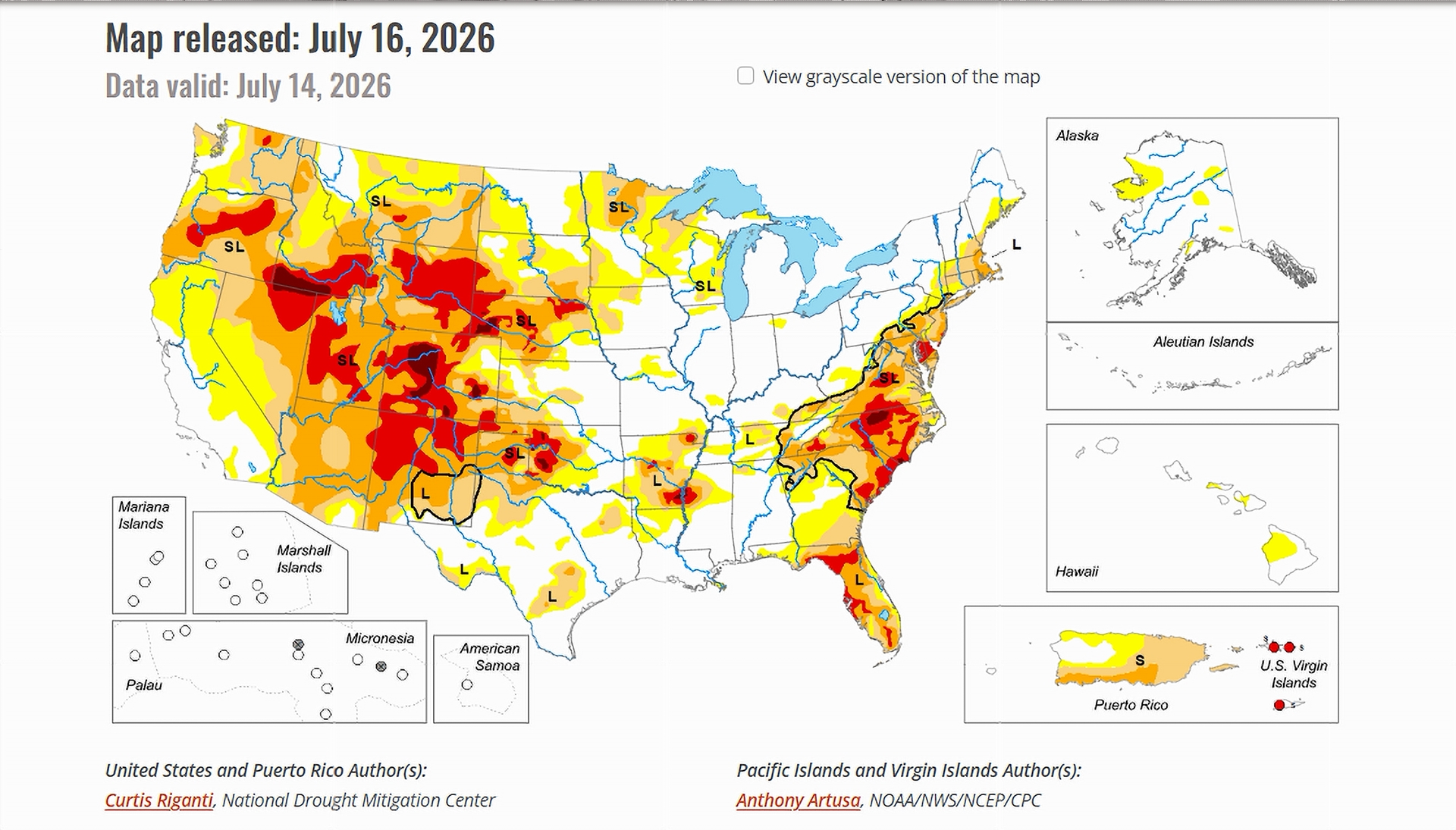
But west of the Rocky Mountains, the story was starkly different. The latest report from the U.S. Drought Monitor , released July 16, 2026, painted a picture of a region under siege — one where dry air dominated, heat records fell, and drought conditions either held steady or grew worse.
The West Stays Dry.
The report noted that, with only limited exceptions, mostly dry weather settled across the western United States this past week. For the seven states that share the Colorado River — Arizona, California, Colorado, Nevada, New Mexico, Utah, and Wyoming — that dryness arrived on top of drought conditions that were already deeply entrenched.
Temperatures across much of the region ran 3 to 6 degrees above normal for the week. In northeast Wyoming and parts of Montana, the mercury climbed 6 to 12 degrees above average. Cities in southern and eastern Montana shattered all-time temperature records on Sunday, July 12, with Miles City reaching 115 degrees Fahrenheit and Billings hitting 111 degrees Fahrenheit. The Drought Monitor noted that the full impact of that heat wave on drought conditions will be assessed in the weeks ahead.
Colorado: Drought Deepens in the Heart of the Basin.
The news from Colorado was among the most sobering in this week’s report. In central parts of the state, drought monitors expanded the coverage of both extreme drought (D3) and exceptional drought (D4) — the two most severe categories on the five-point drought scale.
Exceptional drought, the worst designation possible, signals long-term water supply losses, widespread crop and pasture failures, and exceptional fire risk. It is a designation that water managers, ranchers and municipal planners take with the utmost seriousness.
Eastern Colorado did see some localized improvement after spotty rainfall of roughly 1.5 to 2 inches fell in parts of the state, improving soil moisture and trimming precipitation deficits in places. But those pockets of relief stood in sharp contrast to the broader picture of deepening drought across the state’s midsection.
Utah: A Glimmer of Relief, but No Real Reprieve.
Utah received slightly better news this week, though it offered little comfort in the larger picture. Localized improvements occurred in parts of the state where short-term precipitation deficits eased. Monitors adjusted conditions in those areas to reflect recent rainfall.
Even so, widespread severe drought (D2) and extreme drought (D3) continued to grip most of the state. Streamflow across Utah remained poor. For a state that contributes significantly to the Colorado River system, those low streamflows are a critical concern, as the river’s health depends heavily on snowmelt and runoff from the mountains above.
Arizona and New Mexico: A Hint of Monsoon.
Southeast Arizona received some of the only meaningful rainfall in the region this week, courtesy of the North American Monsoon. Totals of 1 to 2 inches fell in that corner of the state. However, the Drought Monitor noted that those amounts were insufficient to alleviate drought conditions there.
In southeast New Mexico, the picture was slightly brighter. Drought monitors reassessed conditions in that area — along with adjacent parts of western Texas — and made localized improvements where soil moisture, streamflow, and mid-term precipitation deficits had recently recovered.
The Rest of the Basin: Heat and Dryness Prevail.
For California, Nevada and Wyoming — the remaining Colorado River Basin states — the report described a region largely baking under above-normal heat with mostly dry conditions persisting west of the Continental Divide. The report did not cite specific improvements in those states this week.
A Look Ahead: Some Reason for Cautious Optimism.
The forecast offers a measure of hope for the Colorado River Basin states, though meteorologists urge caution about reading too much into short-term weather patterns.
In the near term, heavier rainfall of 2 to 5 inches is forecast for parts of Arizona and western New Mexico, extending north into southwest Colorado, portions of Utah and sections of Wyoming. If those totals materialize, they could provide some short-term relief.
Looking further out, the National Weather Service Climate Prediction Center’s outlook for July 21 through July 25 favors wetter-than-normal conditions across much of the Southwest — particularly in Arizona, New Mexico, Utah and Colorado. That forecast comes with higher confidence than for surrounding areas. It reflects the seasonal influence of the North American Monsoon, which typically brings critical summer moisture to the Four Corners region.
At the same time, above-normal temperatures are still favored across most of the western United States during that period, except in parts of Arizona and New Mexico. That combination of potential rain and lingering heat will determine how much actual drought relief, if any, the region sees.
Data in this report is sourced from the U.S. Drought Monitor, released July 16, 2026. The Drought Monitor is produced through a partnership between the National Drought Mitigation Center at the University of Nebraska-Lincoln, the United States Department of Agriculture and the National Oceanic and Atmospheric Administration. The full report and interactive maps are available at droughtmonitor.unl.edu.