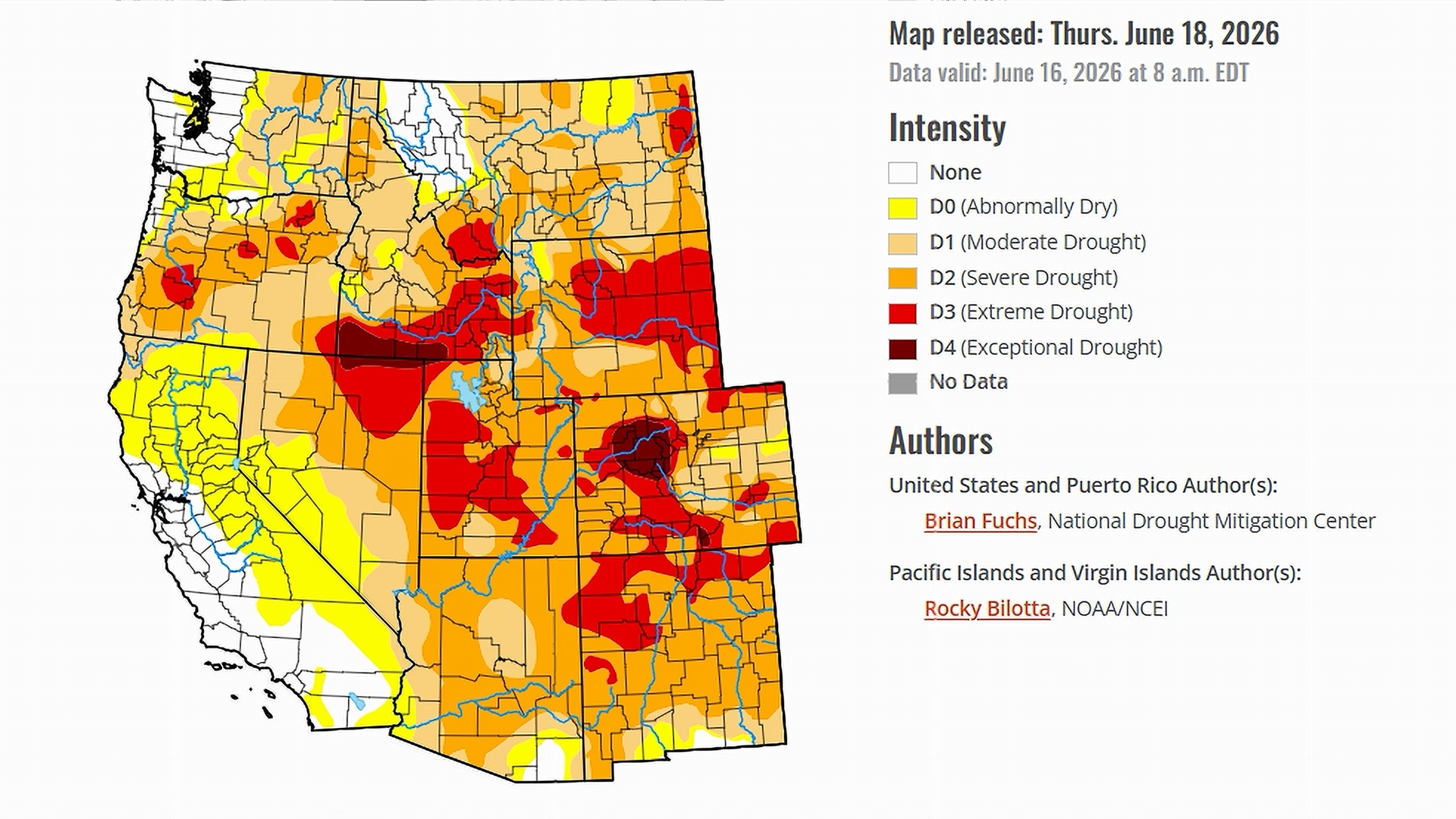
- Central and eastern Colorado saw drought conditions worsen this week, while eastern Utah and western Colorado recorded modest improvement.
- Central Wyoming’s extreme drought expanded as persistent dry conditions continued to grip parts of the northern Rockies.
- New Mexico bucked the regional trend, with several weeks of wetter-than-normal weather easing extreme drought across northeastern and southern portions of the state.
- A dry winter and below-normal snowpack are driving low-flow conditions in Colorado waterways and across other parts of the region.
Saturday, June 20, 2026 — Across the United States, drought is a tale of stark contrasts. While the Midwest and southern Plains soaked up heavy rainfall this past week — some areas recording precipitation totals four to five inches above normal — large stretches of the American West tell a far drier story. As of June 18, 2026, the latest report from the United States Drought Monitor paints a landscape still under significant stress across the seven states that share the Colorado River: Arizona, California, Colorado, Nevada, New Mexico, Utah, and Wyoming.
Flooding rains drenched parts of Texas and the Gulf Coast. Ohio and Indiana are now entirely free of drought. But for communities across the Colorado River Basin, relief has been limited, uneven, and in some places, entirely absent.
Heat Blankets the Southwest.
Temperature was a defining story across the Colorado River Basin this week. California, Nevada, and Arizona experienced some of the warmest departures in the country, with temperatures running six to eight degrees above normal — or higher. That kind of relentless heat accelerates evaporation, stresses crops, and draws down water supplies faster than rainfall can replenish them.
By contrast, portions of Wyoming and the northern Rocky Mountains ran four to six degrees below normal, offering a brief reprieve from the broader warmth pressing down on the West.
Colorado: Improvement in the West, Trouble in the East.
Colorado presents a split picture this week. In the western part of the state, improved short-term moisture conditions helped reduce coverage of extreme drought — a welcome development for a region that has been under prolonged stress. Eastern Utah saw similar, modest gains.
But those bright spots come with a shadow. Central and eastern Colorado experienced drought degradation this week, with worsening conditions driven by a continued lack of rainfall and above-normal temperatures. The report also points to a broader, more worrying trend: the effects of a dry winter and below-normal snowpack are still being felt across Colorado and neighboring areas, where increasing numbers of waterways are now experiencing low-flow conditions. Rivers and streams running well below their normal levels in June carry serious implications for farmers, municipalities, and ecosystems that depend on summer water availability.
Wyoming: Extreme Drought Expands.
In Wyoming, the drought picture worsened. Extreme drought expanded across central portions of the state this week. Northern Wyoming did receive some above-normal precipitation, which offered localized relief, but it was not enough to reverse the broader trend of drying conditions that have taken hold.
To the east, the High Plains section of the report notes that the most severe drought conditions stretch from eastern Wyoming into western and northern Nebraska — a signal of just how extensive and entrenched the dry pattern has become across this part of the country.
New Mexico: A Rare Bright Spot.
Among the seven Colorado River Basin states, New Mexico stands out as the week’s clearest success story. Several weeks of wetter-than-normal conditions allowed forecasters to reduce extreme drought coverage across northeastern and southern portions of the state. That sustained moisture — rare in an otherwise parched region — gave the landscape a chance to begin recovering.
The improvement was not universal. Slight drought expansion was noted in northern New Mexico, a reminder that even positive trends can be uneven in a region with complex terrain and variable rainfall patterns.
Arizona, California, Nevada: Heat Without Much Relief.
Arizona did record some above-normal precipitation this week, a modest positive note. But heat dominated the story for Arizona, California, and Nevada, where temperatures ran well above normal, by six to eight degrees or more in many locations. The report does not detail significant drought improvement for California or Nevada this week.
What Lies Ahead.
The short-term forecast offers little encouragement for the Colorado River Basin. The Climate Prediction Center’s six-to-ten-day outlook calls for above-normal temperatures to continue across much of the western United States. More significantly, below-normal precipitation is expected across most of the West during that same period.
That combination — persistent heat and a dry forecast — suggests that drought conditions across the Colorado River Basin states are unlikely to ease in the near term. For a river system already under pressure from decades of overuse and long-term aridification, each dry week adds to a burden that is already well-documented and deeply felt.